


What's Happening?
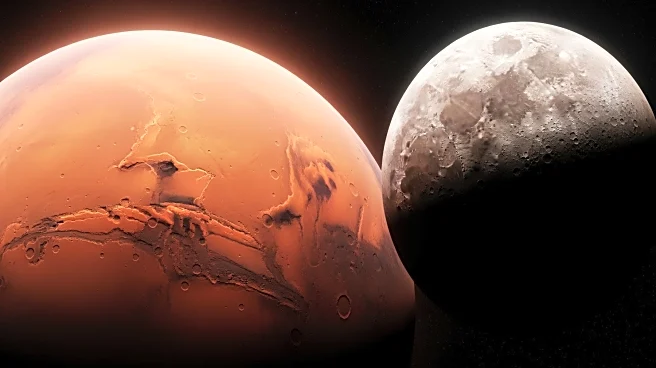
Recent research led by Suniti Karunatillake at Louisiana State University suggests that Mars may have once had a much larger moon. This hypothesis is based on the study of tidal rhythmites found in the Gale crater, which are thin layers within sedimentary
rocks that indicate past tidal activity. The study proposes that a larger moon, significantly more massive than Mars' current moons, Phobos and Deimos, could have exerted the gravitational pull necessary to create tides in ancient Martian lakes and seas. The findings were presented at the American Geophysical Union meeting, sparking debate among scientists. While some experts, like Ranjan Sarkar, support the tidal interpretation, others, such as Christopher Fedo, argue that similar patterns could result from other natural processes, like varying river inflows.
Why It's Important?
The study's implications extend beyond planetary science, as it challenges existing theories about Mars' geological history and its potential to have supported life. Understanding Mars' past environment, including the presence of water and its interaction with celestial bodies, is crucial for future exploration and the search for life. If Mars did have a larger moon, it could reshape our understanding of the planet's evolution and its capacity to sustain life. This research also highlights the importance of interdisciplinary approaches, combining geology, astronomy, and physics, to unravel the mysteries of our solar system.