



What's Happening?
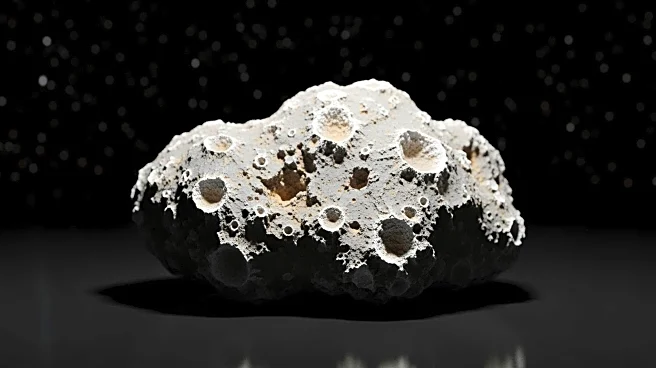
NASA's OSIRIS-REx mission has revealed surprising details about the surface of asteroid Bennu, which is covered in large boulders rather than the expected smooth regolith. Initial observations from Earth-based instruments suggested a sandy surface, but
the spacecraft's findings showed a rugged terrain. The boulders' porosity and extensive crack networks were identified as factors contributing to the asteroid's thermal properties. These findings were confirmed through laboratory analysis of samples returned to Earth, using techniques like X-ray computed tomography and lock-in thermography.
Why It's Important?
Understanding Bennu's surface composition and thermal properties is crucial for future asteroid exploration and potential resource utilization. The mission's findings challenge previous assumptions about asteroid surfaces, providing new insights into their formation and evolution. This knowledge enhances our ability to interpret remote observations of other asteroids and informs the design of future missions. Additionally, studying Bennu's surface contributes to planetary defense strategies by improving our understanding of asteroid behavior and potential impact risks.
What's Next?
The OSIRIS-REx mission's data will continue to be analyzed to refine models of asteroid surfaces and thermal dynamics. Researchers aim to apply these findings to other celestial bodies, enhancing our understanding of the solar system. Future missions may focus on exploring asteroids with similar characteristics, using the insights gained from Bennu to improve landing and sampling techniques. The ongoing study of returned samples will also provide opportunities for further discoveries about the asteroid's composition and history.