








What's Happening?
A major retrospective celebrating the centenary of Marisa Merz, a prominent figure in Italy's Arte Povera movement, is set to take place across three institutions in Turin, Italy. The exhibition, titled 'Marisa Merz – The Dance of the Hours,' will be
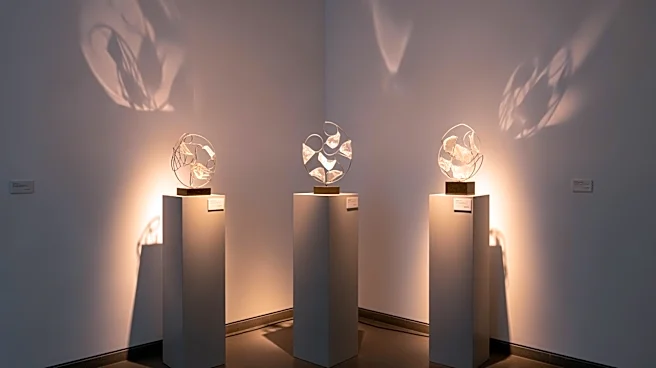
hosted by the Gallery of Modern and Contemporary Art (GAM), the Fondazione Merz, and the Castello di Rivoli. This comprehensive showcase will feature never-before-seen works alongside highlights from Merz's previous exhibitions, including her acclaimed U.S. retrospective in 2017. The exhibitions will explore various aspects of Merz's artistic practice, which includes her 'Living Sculptures' made from aluminum and other materials. The retrospective aims to highlight Merz's unique contribution to the Arte Povera movement, emphasizing her exploration of the metaphysical nature of space and her use of diverse materials.
Why It's Important?
This retrospective is significant as it underscores Marisa Merz's pivotal role in the Arte Povera movement, which was predominantly male-dominated. By showcasing her work across three major institutions, the exhibition not only honors her legacy but also brings attention to the feminine perspective she brought to the movement. This event is likely to enhance Merz's recognition in the art world, potentially influencing contemporary artists and curators. It also provides an opportunity for art enthusiasts and scholars to engage with her work in a comprehensive manner, fostering a deeper understanding of her artistic contributions and the broader context of Arte Povera.
What's Next?
The exhibitions will be accompanied by a single catalog, which will debut at a conference dedicated to Marisa Merz. This conference is expected to further explore her impact on the art world and her innovative approaches to art-making. The date for the conference has not yet been announced, but it is anticipated to attract art historians, critics, and enthusiasts who are interested in Merz's work and the Arte Povera movement. Additionally, the retrospective may inspire future exhibitions and scholarly research focused on Merz and her contemporaries.