



What's Happening?
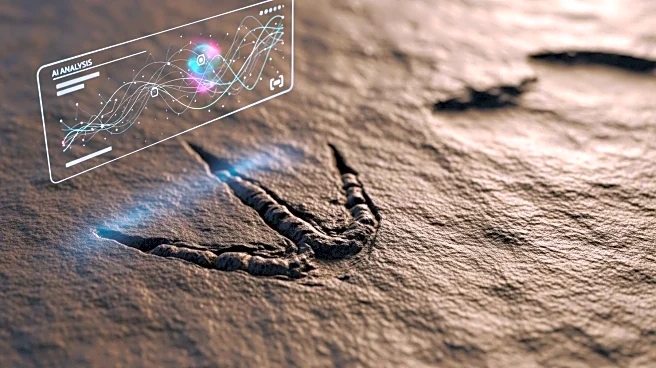
An international research collaboration has developed an AI application called Dinotracker, designed to accurately identify dinosaur footprints. This tool aims to improve the precision of paleontological studies by providing an objective analysis of ancient
trackways, moving beyond traditional subjective interpretations. The project, a joint effort between Germany's Helmholtz-Zentrum and the University of Edinburgh, was published in the Proceedings of the National Academy of Sciences. The AI was trained using a vast dataset of fossil footprints and digitally simulated versions to account for natural distortions. It analyzes eight key characteristics of footprints to deduce the most likely dinosaur responsible. During testing, Dinotracker aligned with human expert classifications in 90% of cases.
Why It's Important?
The introduction of Dinotracker represents a significant advancement in paleontology, offering a more objective method for analyzing fossilized footprints. This technology could lead to more accurate reconstructions of prehistoric ecosystems and improve our understanding of dinosaur behavior and evolution. By reducing human bias in footprint analysis, Dinotracker may also help resolve longstanding debates in the field. The AI's ability to identify morphological similarities between ancient tracks and modern birds could potentially reshape theories about the evolutionary timeline of birds, although researchers caution that complete skeletal fossils are needed for definitive conclusions.
What's Next?
Dinotracker is now available to the scientific community via GitHub, allowing researchers worldwide to utilize and further develop the tool. As more paleontologists adopt this technology, it could lead to new discoveries and insights into dinosaur species and their environments. The ongoing refinement of the AI's algorithms and expansion of its database will likely enhance its accuracy and applicability in various paleontological contexts.
Beyond the Headlines
The use of AI in paleontology highlights the growing intersection of technology and traditional sciences. This development may inspire similar applications in other fields, such as archaeology and geology, where objective analysis of historical artifacts and formations is crucial. Additionally, the ethical implications of relying on AI for scientific interpretation warrant consideration, as the balance between human expertise and machine analysis continues to evolve.