



What's Happening?
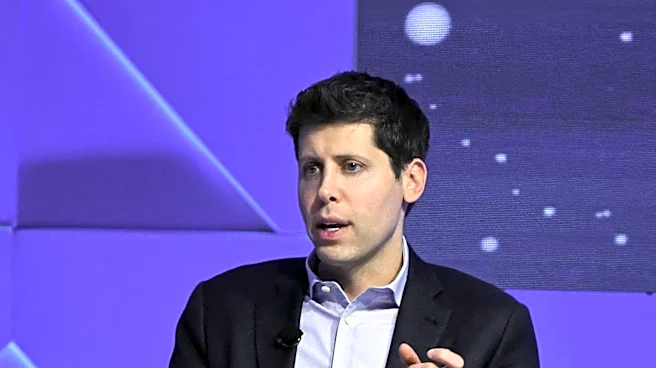
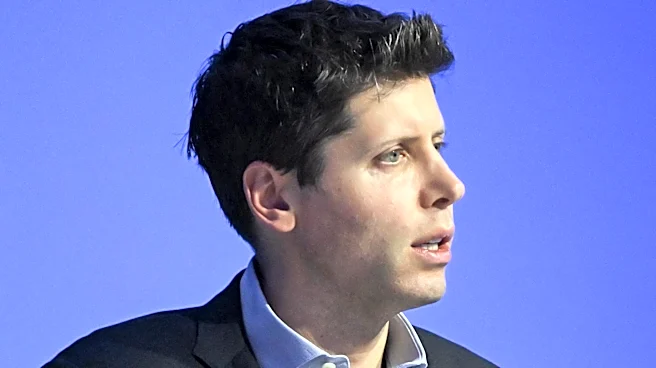
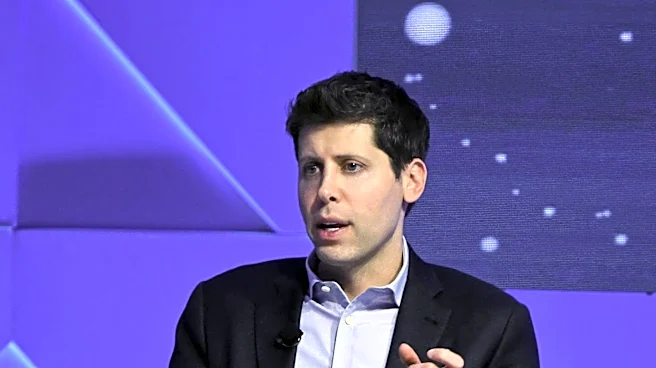
Sam Altman, CEO of OpenAI, has revealed that the company holds numerous undisclosed mathematical discoveries beyond the 700 proofs already made public. In a recent interview, Altman confirmed that OpenAI's substantial investment in mathematical research,
amounting to hundreds of millions of dollars, has yielded many unpublicized findings. He acknowledged a dilemma regarding the public release of these major basic scientific discoveries, advocating for their public dissemination due to humanity's right to access fundamental scientific knowledge. However, Altman also noted the importance of supporting researchers whose career development and sense of achievement are tied to these discoveries. OpenAI is actively adjusting its approach to releasing results, positioning newly published research manuscripts as 'raw research data' and inviting external experts to lead verification efforts, as seen with recent mathematical and computer science outputs.
Why It's Important?
This revelation underscores the accelerating pace of AI-driven scientific discovery and its potential to transform fundamental research across various fields. The existence of numerous undisclosed mathematical breakthroughs suggests that AI is not only assisting in science but actively generating new knowledge at an unprecedented rate. Altman's dilemma highlights a critical challenge for the scientific community: how to balance the imperative of open scientific knowledge with the recognition and support of individual researchers and institutions. The shift towards releasing 'raw research data' and involving external verification signals a new paradigm for scientific validation, where AI acts as a powerful generator of hypotheses and proofs, and human experts focus on interpretation, verification, and integration into existing knowledge. This could lead to a more collaborative and transparent scientific process, but also necessitates robust mechanisms for peer review and quality control.
What's Next?
OpenAI is expected to continue refining its approach to releasing AI-generated scientific discoveries, potentially leading to more structured processes for external verification and academic collaboration. The ongoing 'oai-math-revised' project on GitHub, where mathematics researchers collaboratively revise OpenAI's manuscripts, exemplifies the community's efforts to understand and verify these findings. This collaborative model could become a standard for integrating AI-generated research into the broader scientific discourse. Altman's commitment to finding a way to promote researchers while sharing knowledge suggests that OpenAI may explore new models for academic credit and incentives. Furthermore, the increasing integration of large models into biological research, as evidenced by the rising proportion of bioRxiv preprints disclosing AI use, indicates a broader trend towards AI-assisted scientific inquiry across disciplines. The focus will be on how these AI-generated insights are verified, understood, and ultimately translated into actionable scientific knowledge.
Beyond the Headlines
The existence of undisclosed AI-generated mathematical discoveries raises profound philosophical questions about the nature of creativity, intelligence, and the future role of humans in scientific endeavor. If AI can independently generate fundamental breakthroughs, it challenges traditional notions of human intellectual primacy in discovery. This development also has significant implications for national competitiveness and technological leadership, as the ability to rapidly generate and leverage such knowledge could confer substantial advantages. The ethical considerations surrounding the responsible disclosure and application of these discoveries will become increasingly complex, particularly in fields with dual-use potential. The ongoing dialogue about how to integrate AI into scientific research, ensuring both rapid progress and ethical safeguards, will shape the trajectory of human knowledge and technological advancement for decades to come. This marks a pivotal moment where AI is not just a tool, but a co-creator of scientific understanding.