







What's Happening?
NASA's Artemis 2 mission, which launched on April 1, 2026, is nearing its conclusion as the spacecraft prepares to return to Earth. This mission marks the first crewed flight beyond low Earth orbit since Apollo 17 in 1972, with four astronauts on board.
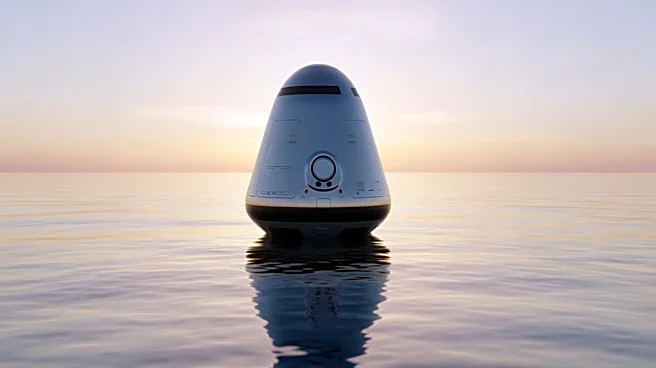
During their journey, the crew traveled thousands of miles beyond the moon and witnessed a total solar eclipse. As the mission enters its final stages, a Virtual Telescope Project livestream will track the Orion spacecraft as it approaches Earth. The livestream, hosted by astrophysicist Gianluca Masi, is scheduled for April 9 at 10:45 p.m. EDT. The spacecraft is expected to splash down in the Pacific Ocean near San Diego on April 10.
Why It's Important?
The Artemis 2 mission is a significant milestone in NASA's efforts to return humans to the moon and eventually establish a sustainable presence there. This mission serves as a precursor to future lunar exploration and potential Mars missions. The successful completion of Artemis 2 will demonstrate the capabilities of the Orion spacecraft and the Space Launch System, reinforcing NASA's leadership in space exploration. The mission's success could also inspire international collaboration and investment in space technology, benefiting scientific research and technological advancements.
What's Next?
Following the splashdown of Artemis 2, NASA will conduct a thorough analysis of the mission's data to assess the performance of the spacecraft and systems. This analysis will inform the planning and execution of future Artemis missions, including Artemis 3, which aims to land astronauts on the lunar surface. The success of Artemis 2 could accelerate timelines for subsequent missions and influence international partnerships in space exploration.