



What's Happening?
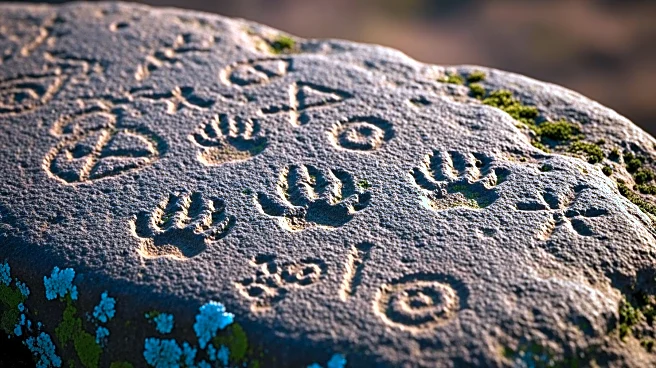
In eastern Ohio, a sandstone boulder known as the Barnesville Petroglyph is etched with over a hundred ancient carvings, including animal tracks, human faces, and abstract forms. Despite extensive study, the origins and purpose of these carvings remain
unclear. The site, often referred to as 'Track Rocks' by locals, has intrigued archaeologists and the public for generations. Some experts initially attributed the carvings to the Adena culture, which existed from 500 BC to AD 300. However, comparisons with other regional sites suggest a connection to the Monongahela culture, active around AD 1200. The carvings are believed to be the work of Indigenous peoples, but no single theory has gained consensus. The petroglyphs have suffered damage over time, including vandalism and natural erosion, with fewer than 70 of the original carvings still visible.
Why It's Important?
The Barnesville Petroglyph is a significant cultural landmark, offering insights into the region's Indigenous history. The carvings' uncertain origins highlight the complexities of interpreting ancient artifacts and the challenges in preserving them. The site underscores the importance of protecting cultural heritage from both natural decay and human interference. The petroglyphs' connection to multiple Indigenous cultures suggests a rich tapestry of historical interactions in the Ohio Valley. This site serves as a reminder of the need for ongoing research and conservation efforts to safeguard such irreplaceable cultural resources.
What's Next?
Efforts to preserve the Barnesville Petroglyph continue, with local authorities and historians advocating for increased protection and awareness. The site remains accessible to the public, but visitors are encouraged to respect its fragile condition. Future research may focus on advanced imaging techniques to better understand the carvings and their origins. Additionally, there may be initiatives to educate the public about the site's historical significance and the broader context of Indigenous cultures in the region. Preservation strategies could include measures to prevent further vandalism and natural erosion.
Beyond the Headlines
The Barnesville Petroglyph raises broader questions about the interpretation of ancient artifacts and the narratives constructed around them. The site's ambiguous origins challenge assumptions about cultural boundaries and highlight the interconnectedness of Indigenous groups. The petroglyph also reflects broader themes of cultural resilience and the enduring legacy of Indigenous peoples in North America. As interest in the site grows, it may inspire discussions about the ethical responsibilities of archaeologists and historians in representing Indigenous histories. The petroglyph's preservation is not only a matter of historical interest but also a testament to the cultural heritage of the region's original inhabitants.