



What's Happening?
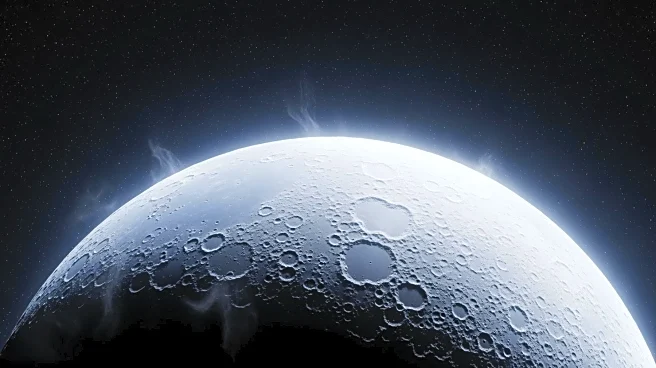
Recent research has uncovered that particles from Earth's atmosphere have been transported to the moon by solar wind for billions of years, integrating into the lunar soil. This discovery challenges previous assumptions that Earth's magnetic field would
prevent such a transfer. Instead, the magnetic field may facilitate the movement of atmospheric particles to the moon, particularly when the moon passes through Earth's magnetotail during its full-moon phase. This process has contributed to the presence of volatile gases like oxygen and nitrogen on the moon, which could be valuable for future lunar exploration and potential colonization efforts.
Why It's Important?
The findings have significant implications for lunar exploration and the potential establishment of lunar colonies. The presence of elements such as oxygen and hydrogen on the moon's surface could provide essential resources for sustaining human activities, reducing the need to transport materials from Earth. This could lead to advancements in space exploration technology and strategies, as well as a deeper understanding of the moon's composition and its historical interaction with Earth. The study also offers insights into Earth's ancient atmosphere, which could inform our understanding of the planet's evolutionary history and the development of life.
What's Next?
Future lunar missions, including robotic landers and human expeditions, may focus on analyzing the volatile elements in the lunar regolith to further validate these findings. The recent acquisition of new lunar soil samples by China's Chang'e missions provides an opportunity to test the study's conclusions. Additionally, the research could influence the planning and design of lunar bases, emphasizing the use of local resources for sustainability. Continued exploration and analysis of the moon's surface will likely yield more information about the historical exchange of materials between Earth and the moon.
Beyond the Headlines
This study highlights the complex chemical interactions between Earth and the moon, suggesting a long-term material exchange that has influenced both bodies' evolution. Understanding this relationship could offer new perspectives on planetary formation and the interconnectedness of celestial bodies. The research also underscores the importance of interdisciplinary approaches in space science, combining physics, astronomy, and geology to unravel the mysteries of our solar system.