





What's Happening?
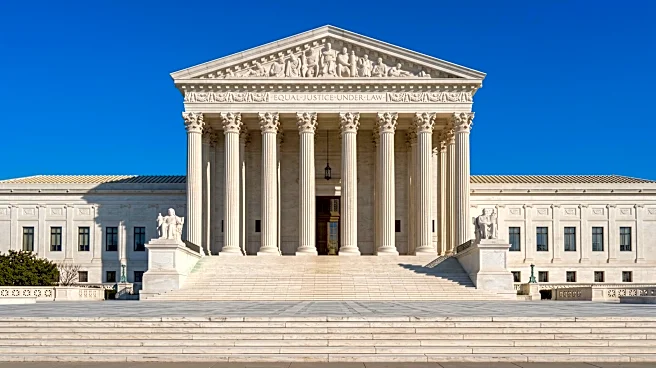
The National Republican Congressional Committee (NRCC) has accused Congresswoman Emilia Sykes and other House Democrats of seeking to 'pack the United States Supreme Court with liberal justices.' According to the NRCC, Sykes's vote against a constitutional
amendment that would permanently preserve the Supreme Court at nine justices indicates her support for this action. NRCC Spokesman Zach Bannon stated that this vote makes it clear that if Sykes and 'radical House Democrats' gain power, they would use it to 'fundamentally transform America into an unrecognizable socialist hellscape.' The NRCC views this as an attempt to undermine democracy and advance a 'radical socialist agenda.'
Why It's Important?
This accusation from the NRCC is highly significant as it targets a core institution of American democracy: the Supreme Court. The concept of 'court packing,' or expanding the number of justices to alter the ideological balance, is a contentious issue with deep historical roots and profound implications for the judiciary's independence and the balance of power. For the NRCC, framing Sykes's vote as support for court packing is a powerful political attack, aiming to portray her as an extremist who threatens the stability of the U.S. legal system. This narrative can mobilize conservative voters and potentially sway moderate voters who value judicial impartiality. The debate over court packing touches upon the very structure of government and the long-term direction of legal and social policy in the United States.
What's Next?
The NRCC's accusation is likely to be a prominent feature in future political campaigns, particularly in Ohio's 13th Congressional District. Congresswoman Sykes will likely face continued pressure to clarify her stance on the Supreme Court's composition and the constitutional amendment she voted against. This issue could become a key talking point in debates and campaign advertisements, with Republicans using it to question her commitment to democratic norms and judicial independence. The broader discussion around court packing will continue to be a significant national political issue, influencing judicial appointments, legislative efforts, and public discourse on the role of the Supreme Court in American society. Both sides will likely intensify their efforts to shape public opinion on this critical matter.
Beyond the Headlines
The debate over court packing delves into fundamental questions about the nature of judicial power and its relationship to political branches. Historically, attempts to alter the Supreme Court's size have been met with strong opposition, seen as a threat to the judiciary's independence and its role as a check on legislative and executive power. The NRCC's rhetoric, using terms like 'undermine democracy' and 'socialist hellscape,' highlights the deep ideological chasm and the high stakes involved. This issue also raises ethical considerations about the politicization of the judiciary and the potential for short-term political gains to compromise long-term institutional integrity. The long-term implications of such actions could include a loss of public trust in the courts, increased partisan gridlock, and a more volatile legal landscape, fundamentally altering the balance of power within the U.S. government.