




What's Happening?
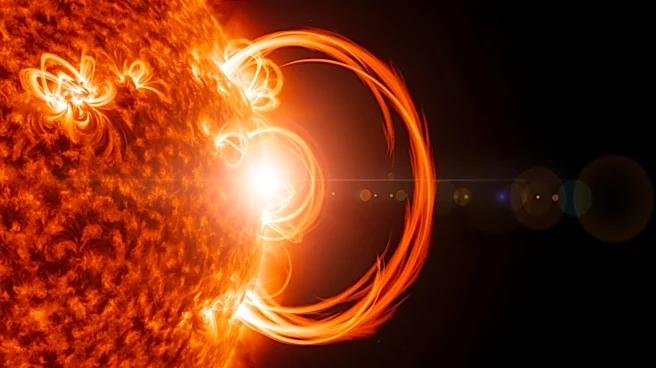
NASA's Solar Dynamics Observatory has captured a strong solar flare from the Sun, peaking at 7:28 a.m. ET on June 3, 2026. This flare is classified as an X1.0 flare, indicating its intensity. Solar flares are powerful bursts of energy that can impact
radio communications, electric power grids, navigation signals, and pose risks to spacecraft and astronauts. The observatory's image shows the flare as a bright flash in extreme ultraviolet light, highlighting the hot material involved. NASA continues to monitor the Sun's activity and its effects on space weather, collaborating with NOAA's Space Weather Prediction Center to assess potential impacts on Earth.
Why It's Important?
Solar flares can have significant effects on Earth's technological systems, including disruptions to communication networks and power grids. Understanding and predicting these events are crucial for mitigating their impact on infrastructure and ensuring the safety of astronauts in space. NASA's continuous observation of solar activity helps in forecasting space weather and preparing for potential disruptions. The data collected from such flares contribute to the broader understanding of solar dynamics and their influence on Earth's environment.