


What's Happening?
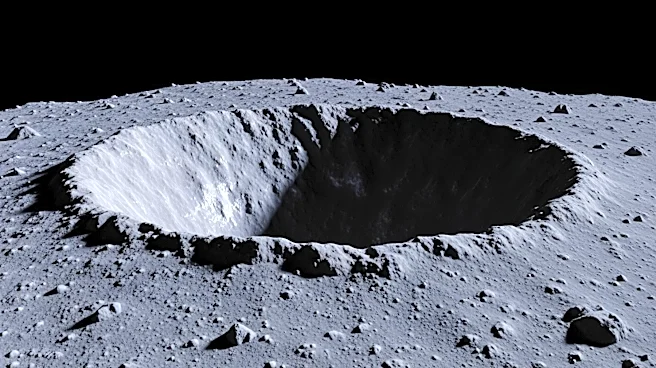
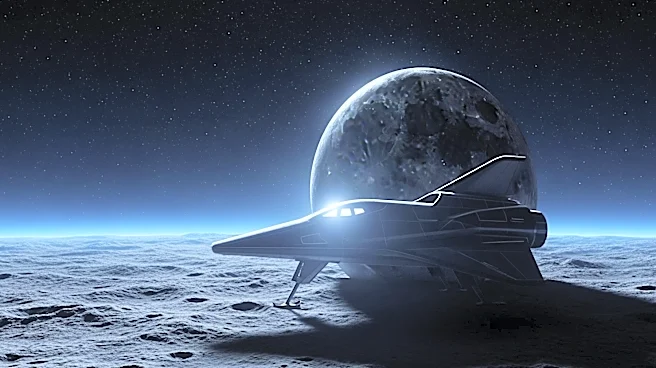
Recent research suggests that the moon's oldest and darkest craters, particularly those at the lunar south pole, may contain significant amounts of water-ice. This discovery is based on data from NASA's Lunar Reconnaissance Orbiter and other missions,
which indicate that water-ice is not uniformly distributed across these craters. The study, led by planetary scientists including Paul Hayne, Oded Aharonson, and Norbert Schörghofer, proposes that the water-ice likely accumulated gradually over billions of years rather than from a single cometary impact. The presence of water-ice is crucial for future lunar missions, as it can be used for drinking, rocket fuel, and breathable air.
Why It's Important?
The potential presence of water-ice on the moon is significant for future space exploration and the establishment of lunar bases. Water is a vital resource for sustaining human life and can be split into hydrogen and oxygen for fuel and air. This discovery could reduce the need to transport water from Earth, making lunar missions more feasible and cost-effective. Additionally, understanding the distribution and origin of lunar water-ice can provide insights into the moon's geological history and the solar system's evolution.
What's Next?
Further exploration and analysis are needed to confirm the presence and quantity of water-ice in these craters. The development of new instruments, such as the Lunar Compact Infrared Imaging System (L-CIRiS), is underway to obtain more detailed observations. Scheduled to fly to the moon in 2027, these efforts will help determine the viability of using lunar water-ice for future missions. Continued research may also explore the potential for extracting and utilizing this resource in situ.
Beyond the Headlines
The discovery of water-ice on the moon raises questions about its origin, with possibilities including gradual accumulation from asteroid impacts or contributions from Earth's atmosphere. This finding also highlights the dynamic nature of the moon's environment, where changes in its tilt have affected the shadowing of craters over time. The study of lunar water-ice could lead to broader implications for understanding water distribution in the solar system and the potential for life-supporting environments beyond Earth.