
What's Happening?
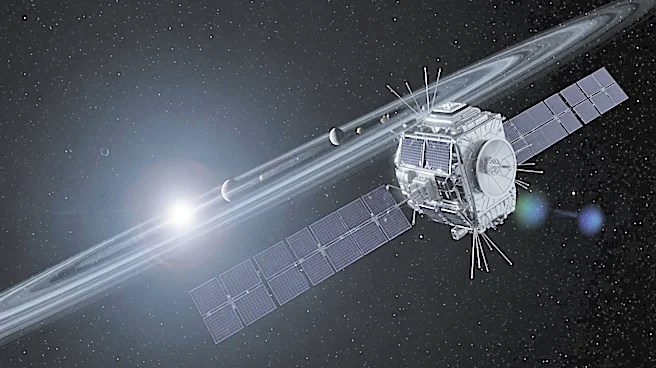
The James Webb Space Telescope has made a groundbreaking discovery by confirming the first direct detection of giant water ice clouds on an exoplanet, Epsilon Indi Ab, located 12 light-years from Earth.
This super-Jupiter exoplanet, part of the Epsilon Indi system, has an upper atmosphere with temperatures around 275 Kelvin. The discovery was announced by the Max Planck Institute for Astronomy and published in the Astrophysical Journal Letters. The presence of water ice clouds, previously only theorized, suggests more active vertical transport processes in the atmosphere than previously assumed. This finding necessitates the inclusion of ice clouds in future atmospheric models, which are crucial for identifying biosignatures and habitability indicators on other planets.
Why It's Important?
This discovery has significant implications for the field of exoplanetary science. The presence of water ice clouds on Epsilon Indi Ab challenges existing atmospheric models for cold giant planets, which did not predict such phenomena. The finding suggests that current models need to be revised to include ice clouds as a standard element, which could impact the search for biosignatures and habitability indicators on other planets. This advancement in understanding exoplanetary atmospheres could lead to more accurate predictions about the conditions on distant worlds, potentially aiding in the search for life beyond Earth.
What's Next?
Future studies of Epsilon Indi Ab will focus on testing the stability of the clouds at different points in the planet's orbit, which could reveal new interplanetary meteorological dynamics. The MPIA team plans to observe other cold giant planets in nearby systems using the James Webb Space Telescope. Additionally, upcoming missions like the Nancy Grace Roman Space Telescope and the Habitable Worlds Observatory will expand the catalog of giant planets and focus on searching for indicators of habitability, building on the methods established by this discovery.