





What's Happening?
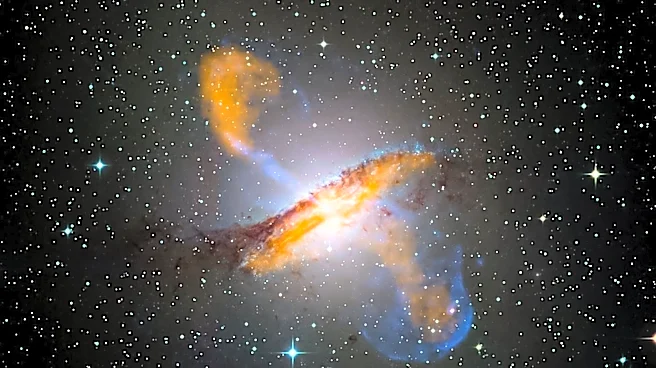
Scientists utilizing NASA's Chandra X-ray Observatory, in conjunction with the German Extended ROENTGEN Survey with an Imaging Telescope Array (eROSITA) X-ray telescope, have observed unusual radio waves forming a 'treble clef' shape deep in space. This
phenomenon is believed to be the result of an outburst from a supermassive black hole. Researchers suggest that this outburst propelled clouds of charged particles and magnetic fields away from the center of a galaxy cluster, generating bright radio waves. The observed structure, which includes a large cloud of blue gas and bright pink radio signals, is thought to be a massive galaxy cluster composed of two merging clusters. This discovery provides insight into the origins of these distinctive radio signals, as detailed in a new study published in the journal Astronomy & Astrophysics.
Why It's Important?
This discovery significantly advances our understanding of cosmic phenomena and the behavior of supermassive black holes. The 'treble clef' radio signal offers a unique opportunity to study the aftermath of powerful black hole outbursts and their impact on galaxy clusters. The re-energization of charged particles through cosmic collisions, which amplifies these radio signals, provides crucial data for astrophysicists. This research contributes to a broader comprehension of the universe's violent and chaotic events, moving beyond the perception of space as merely peaceful and colorful. Understanding these processes can refine models of galaxy formation and evolution, impacting the field of astrophysics and potentially leading to new theoretical frameworks.
What's Next?
Future research will likely focus on further analyzing the data from the Chandra X-ray Observatory and eROSITA to gain a more detailed understanding of the physical processes involved in the formation of these treble clef-shaped radio signals. Scientists may use this information to develop more sophisticated simulations of black hole outbursts and galaxy cluster mergers. Continued observation of similar phenomena could help confirm the proposed mechanisms and identify other instances of such cosmic events. This could lead to a more comprehensive catalog of black hole activity and its influence on the intergalactic medium, potentially guiding the development of new observational techniques and theoretical models in astronomy.
Beyond the Headlines
The observation of the 'treble clef' radio signal underscores the dynamic and often violent nature of the cosmos, challenging the common perception of space as a serene void. This event highlights the immense power of supermassive black holes, which can profoundly influence their galactic environments through energetic outbursts. The study also emphasizes the collaborative nature of modern astronomy, utilizing multiple advanced telescopes to piece together complex cosmic puzzles. This ongoing exploration of the universe's extreme phenomena not only expands scientific knowledge but also inspires a deeper appreciation for the intricate and powerful forces that shape our universe, pushing the boundaries of human understanding.