



What's Happening?
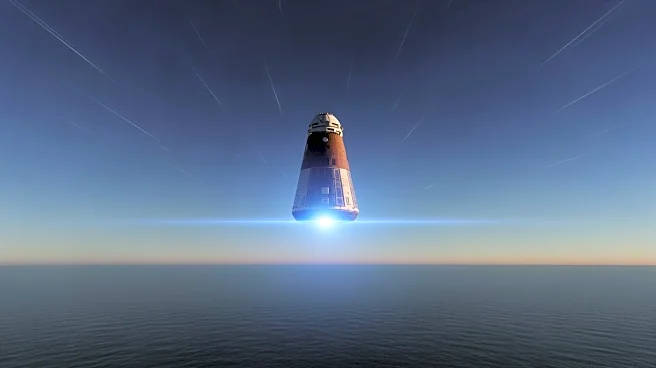
NASA's Crew-11 mission, consisting of NASA astronauts Zena Cardman and Mike Fincke, JAXA astronaut Kimiya Yui, and Roscosmos cosmonaut Oleg Platonov, returned to Earth a month earlier than planned due to a medical evacuation. The crew splashed down safely
in the Pacific Ocean off San Diego after undocking from the International Space Station (ISS). This marks the first medical evacuation from the ISS in over 25 years of continuous human presence. The mission, which began on August 1, 2025, was cut short after one astronaut developed a serious but stable medical condition, prompting NASA to cancel a planned spacewalk and decide on an early return for medical evaluation. The crew had spent 167 days in space, logging 2,672 orbits of Earth.
Why It's Important?
The early return of Crew-11 has significant implications for the operations of the International Space Station. With the crew's departure, the ISS is left with only three occupants, reducing its capacity for scientific experiments and maintenance activities. Typically, the ISS hosts a crew of seven, which allows for a more robust schedule of research and upkeep. The reduced crew size could delay or limit ongoing projects and experiments. Additionally, the incident underscores the challenges and risks associated with long-duration space missions, particularly the need for contingency plans for medical emergencies. The situation also highlights the importance of international collaboration in space exploration, as the crew included astronauts from NASA, JAXA, and Roscosmos.
What's Next?
The next crew rotation, SpaceX's Crew-12 mission, is scheduled to launch no earlier than February 15, 2026, from Florida's Space Coast. This mission will bring NASA astronauts Jessica Meir and Jack Hathaway, European Space Agency astronaut Sophie Adenot, and Russian cosmonaut Andrey Fedyaev to the ISS. Until then, the reduced crew will have to manage the station's operations with limited resources. The upcoming launch will restore the ISS to its full operational capacity, allowing for the resumption of a full schedule of scientific research and maintenance activities. The incident may also prompt NASA and its partners to review and enhance their medical protocols and emergency response strategies for future missions.