







What's Happening?
SupportVectors, a community focused on Generative AI, LLMs, and Agents, is hosting a hybrid event titled 'An Introduction to Networking For AI Training' on Sunday, November 1, 2026, at 5:00 PM Pacific Time. The event, featuring guest speaker Rip Sohan
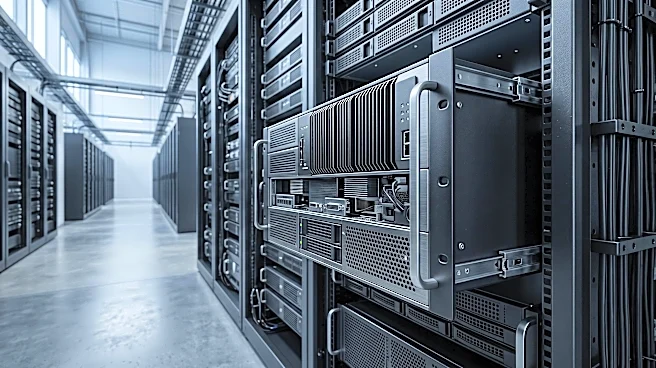
from Broadcom, will address the critical networking limitations encountered as AI models scale across massive compute clusters. The discussion will delve into why existing networking standards and transport mechanisms are proving insufficient for the demands of large-scale AI training. Sohan will outline the core principles of this challenge and explore how emerging industry standards are being developed to overcome these performance bottlenecks. Attendees are expected to gain a clearer understanding of current scaling challenges and the key networking innovations that are shaping the next generation of AI infrastructure.
Why It's Important?
The ability to efficiently train increasingly complex AI models is fundamental to the advancement of artificial intelligence. Current networking limitations pose a significant hurdle, directly impacting the speed, cost, and scalability of AI development. Addressing these challenges is crucial for U.S. technology companies and research institutions that are at the forefront of AI innovation. Improved networking infrastructure will enable faster model training, leading to quicker deployment of new AI applications and services across various sectors, including healthcare, finance, and autonomous systems. This event highlights the critical role of underlying hardware and network architecture in unlocking the full potential of AI, benefiting companies that develop AI hardware, cloud service providers, and ultimately, end-users of AI technologies.
What's Next?
The discussion at the SupportVectors event is expected to shed light on the future direction of networking technologies for AI. It will likely emphasize the need for continued research and development in high-bandwidth, low-latency networking solutions specifically designed for AI workloads. This could lead to new industry standards, specialized hardware, and innovative network protocols. The insights shared by Rip Sohan from Broadcom, a key player in networking technology, will be particularly relevant for professionals and organizations involved in building and managing AI infrastructure. The event aims to equip attendees with a 'clear mental model' of these challenges, suggesting a focus on practical understanding and potential solutions that can be applied in real-world AI development environments.
Beyond the Headlines
The technical challenges in networking for AI training extend beyond mere speed and capacity; they touch upon fundamental aspects of distributed computing and data management. As AI models become more sophisticated and require even larger datasets, the efficiency of data transfer and processing across vast networks becomes a bottleneck. This necessitates a re-evaluation of traditional network architectures and the adoption of more specialized, AI-centric designs. The development of these advanced networking solutions could also have broader implications for other data-intensive fields, potentially driving innovation in areas like scientific computing, big data analytics, and cloud infrastructure. The ethical implications of powerful AI, while not directly addressed by networking, are indirectly supported by the infrastructure that enables its development, making robust and efficient networking a silent but critical enabler of future AI capabilities.