


What's Happening?
A study from TU Wien suggests that particles may not follow the paths predicted by Einstein's general theory of relativity when quantum effects are considered. Researchers have developed a new equation, the q-desic equation, which indicates that in a quantum spacetime,
particles do not always move along the shortest path between two points. This study attempts to merge quantum theory and general relativity by applying quantum rules to spacetime metrics, potentially offering a measurable way to test different theories of quantum gravity.
Why It's Important?
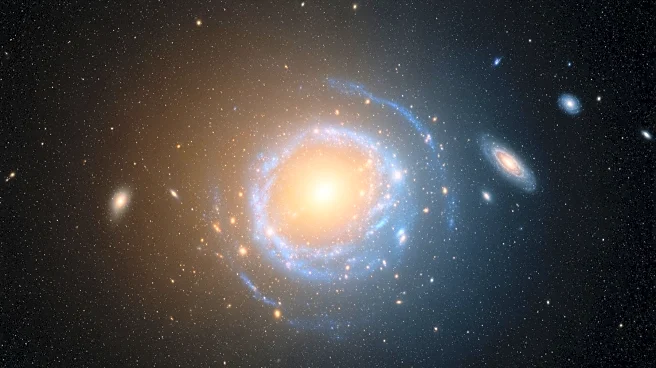
This research is crucial as it addresses one of the biggest challenges in modern physics: unifying quantum theory and general relativity. By proposing a new framework for understanding particle paths in a quantum spacetime, the study could lead to a better understanding of cosmic phenomena and the universe's fundamental forces. The findings may provide a path toward testing theoretical predictions with real observations, potentially resolving longstanding puzzles in cosmology, such as the rotation speeds of spiral galaxies.
What's Next?
The next steps involve further developing this approach to gain new insights into cosmic phenomena. Researchers aim to analyze the implications of the q-desic equation in more detail, particularly its effects on large cosmological scales. This could lead to observational tests that distinguish between competing theories of quantum gravity, potentially advancing our understanding of the universe's structure and behavior.