




What's Happening?
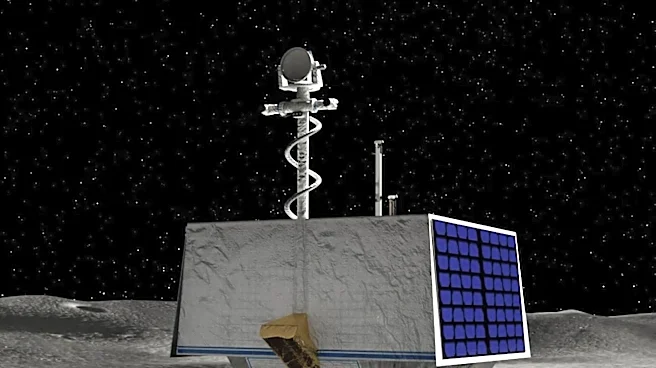
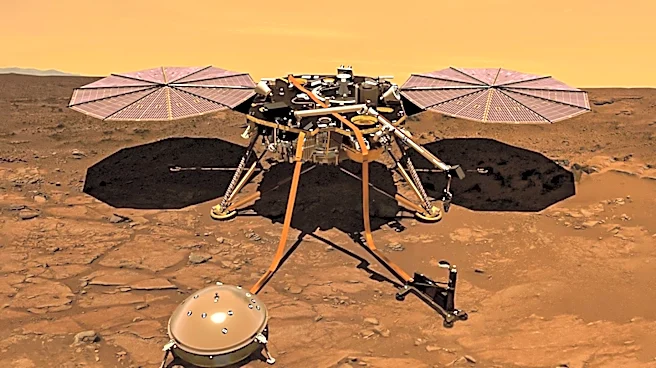
Recent findings from NASA's InSight mission have unveiled that Mars once harbored vast magma seas within its crust, significantly altering the understanding of the planet's geological history and potential for habitability. The InSight seismometer, operational
from 2018 to 2022, detected a distinct boundary at a depth of approximately 24 kilometers, where the rock composition changes sharply. Above this boundary lies a thick layer of mafic rocks, rich in iron, magnesium, and silica, while denser ultramafic rocks, depleted in silica, are found below. This stratification suggests the existence of prolonged magma seas, where denser materials sank and lighter ones remained on top, a process known as differentiation. This discovery challenges previous assumptions that Mars' crust was uniform and highlights the planet's complex geological history.
Why It's Important?
The revelation of Mars' complex magmatic history has significant implications for understanding planetary habitability. The presence of large-scale magmatic systems could have maintained conditions conducive to life by sustaining a greenhouse effect and promoting the presence of liquid water. This geological activity could have extended the period during which Mars had a thicker atmosphere, potentially supporting life. The findings suggest that similar processes might occur on other planets, expanding the potential habitable zone in the universe. Additionally, the discovery of complex volcanic systems on Mars could inform future crewed missions and the potential for resource utilization on the planet.
What's Next?
The study, published in Nature Astronomy, opens new avenues for research into Mars' geological past and its implications for life. Future missions may focus on exploring these magmatic systems further to understand their role in Mars' climate history. The findings also encourage the search for similar geological features on other planets, which could redefine the criteria for habitability beyond Earth. As scientists continue to analyze data from Mars, the potential for discovering past life or conditions that could have supported life remains a key focus.
Beyond the Headlines
The discovery of Mars' magmatic history not only reshapes the understanding of the planet's past but also raises questions about the uniqueness of Earth's geological processes. The ability of Mars to form a complex crust without plate tectonics suggests that life-supporting conditions could arise on a broader range of planets than previously thought. This challenges the notion of Earth's uniqueness in the solar system and prompts a reevaluation of the factors necessary for life. The study also highlights the importance of geological recycling in maintaining habitable conditions, a process that could be crucial for future planetary exploration and colonization efforts.