






What's Happening?
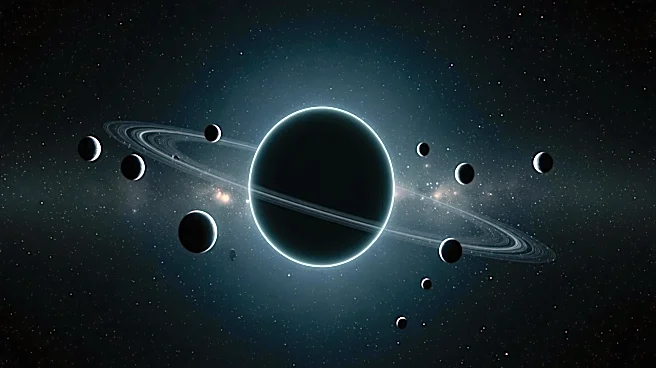
A recent study published in the journal Icarus suggests that the moons of Uranus may hold clues to the existence of missing planets in the solar system. Researchers analyzed 122 scenarios of planetary instability to understand how Uranus' moons could
have been affected by past cosmic events. The study indicates that the moons were likely destabilized twice: first by an impact that tilted Uranus, and then by close encounters with other giant planets. This instability suggests that more giant planets may have existed in the solar system than are present today, potentially being ejected into interstellar space.
Why It's Important?
The findings provide significant insights into the early dynamics of the solar system, suggesting a more complex history than previously understood. If additional giant planets once existed, their interactions could explain the current orbital configurations of the remaining planets. This research could reshape our understanding of planetary formation and migration, offering a new perspective on the forces that shaped our solar system. The study also highlights the potential for discovering more about the solar system's past through the examination of celestial bodies like Uranus' moons.
What's Next?
Future missions to Uranus, such as those being considered by NASA and ESA for the 2040s, could provide more direct evidence of past planetary instability. These missions might confirm whether moons like Miranda are remnants of larger bodies, offering further proof of the study's hypothesis. Continued simulations and observations will be crucial in piecing together the solar system's history and understanding the potential existence of other missing planets.