





What's Happening?
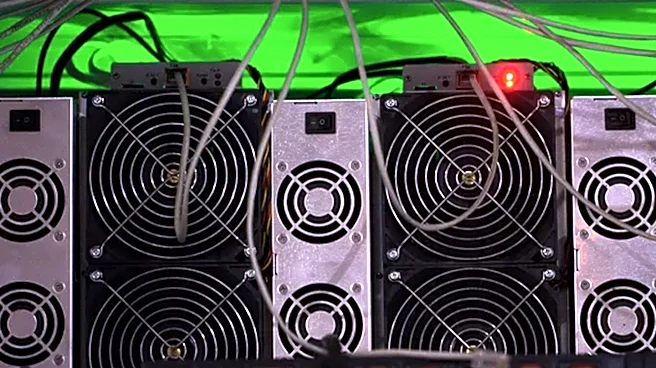
A Reddit user, markpronkin, reportedly purchased an old crypto mining rig for approximately $35 (3,000 rubles) after discovering it in a damp garage. Despite the rig's rusty condition and the seller's refusal for a pre-purchase test, all nine Nvidia P106-100
GPUs, offering a combined 54GB of VRAM, were found to be functional. The user successfully ran a 35-billion-parameter AI model, Qwen3.6-35B-A3B, locally using Ollama, achieving over 30 tokens per second. The P106-100 GPUs are Pascal-generation cards, each with 6GB of GDDR5, originally released around mid-2017. While CUDA 13.0 no longer supports offline compilation for GPUs below compute capability 7.5, security updates for these cards are guaranteed through October 2028. The system's main limitation is a weak Celeron CPU and minimal system memory, and the PCIe 2.0 x1 motherboard slots also present a bottleneck.
Why It's Important?
This event highlights the potential for repurposing older, specialized hardware, like crypto mining rigs, for modern applications such as artificial intelligence, particularly for enthusiasts seeking cost-effective solutions. The acquisition demonstrates that significant VRAM capacity can be obtained at a fraction of the cost of new, high-end GPUs, offering an alternative for local AI model deployment. The ability to run a 35-billion-parameter AI model at over 30 tokens per second on a $35 setup challenges the perception that advanced AI processing requires prohibitively expensive, cutting-edge hardware. This could democratize access to powerful AI capabilities for individuals and small-scale projects, fostering innovation outside of large corporate or academic environments. The low cost per gigabyte of VRAM (approximately 65 cents) compared to newer cards like the RTX 5090 (which costs significantly more per GB) underscores the economic viability of such ventures, especially for users with access to inexpensive or free electricity.
What's Next?
The Reddit user plans to transfer the acquired hardware to a more robust case that supports an i7-7700K CPU and 32GB of RAM, which would allow for better overall system performance. The new case can accommodate up to 12 GPUs, indicating an intention to expand the VRAM capacity to 72GB by purchasing three additional P106-100 cards. This upgrade aims to enhance the rig's capability for running larger AI models and improve processing speeds. The user emphasizes the desire for "unlimited usage and actual privacy" through self-hosted AI solutions, suggesting a move towards greater autonomy in AI development and application. This initiative could inspire other enthusiasts to explore similar hardware repurposing projects, potentially leading to a growing community focused on affordable, private AI infrastructure. Future tests will likely involve running more complex or larger Mixture-of-Experts (MoE) models that fit within the expanded VRAM, pushing the boundaries of what can be achieved with budget-friendly, older hardware.
Beyond the Headlines
This development points to a broader trend of hardware repurposing and the evolving landscape of AI accessibility. As AI models become more sophisticated, the demand for computational resources, particularly VRAM, increases. However, the high cost of new, top-tier GPUs can be a barrier. This case illustrates how the depreciation of specialized hardware, like crypto mining GPUs, can create opportunities for new uses, extending their lifecycle and reducing electronic waste. It also touches upon the growing desire for privacy and control over personal data and AI applications, as users seek alternatives to cloud-based services. The concept of "unlimited usage and actual privacy" through self-hosted AI solutions could become a significant driver for innovation among independent developers and researchers. Furthermore, this scenario highlights the ingenuity within online communities like Reddit, where individuals share knowledge and find creative solutions to technical challenges, fostering a culture of DIY AI development.