







What's Happening?
The history of U.S. toll roads dates back to the late 1790s with the establishment of the Philadelphia and Lancaster Turnpike in 1795, where travelers paid fees at 'spiked gates' or 'pikes.' These early turnpikes were privately built. Modern toll roads,
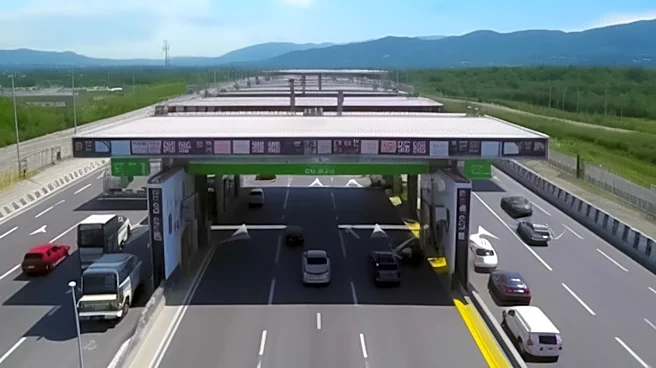
as we know them today, began to emerge in the 1930s, with the Pennsylvania Turnpike, opened in 1940, being a landmark development. Funded by the New Deal to stimulate the economy, it became the nation's first superhighway and a model for the future Interstate Highway System. The 1956 Federal Aid Highway Act introduced massive federal funding via gas taxes, largely banning traditional toll gates on new interstate routes to promote high-velocity transit. However, existing state roads that remained independent continued to charge tolls. Today, modern tolling has transitioned to open-road systems using overhead gantry sensors and transponders like E-ZPass, facilitating friction-free, fully digital transactions. Revenue from these tolls funds maintenance, repairs, and upgrades not covered by federal gas taxes.
Why It's Important?
The evolution of U.S. toll roads reflects the changing needs of transportation infrastructure and funding mechanisms. From private ventures to state-led projects and eventually integrated into the federal highway system, tolls have consistently played a role in financing road construction and maintenance. The shift to electronic tolling, like E-ZPass, has significantly improved efficiency, reduced congestion, and enhanced safety by eliminating physical stops. This modernization is crucial as the U.S. faces challenges such as declining gas tax revenues and aging infrastructure. Tolls provide a dedicated funding source, allowing for continuous investment in road networks. Understanding this history is vital for current policy debates on infrastructure funding, as states explore expanding tolling to maintain and modernize highways without increasing general taxes, and consider dynamic pricing models to manage traffic flow.
What's Next?
The future of U.S. toll roads is expected to involve further technological advancements and policy adjustments. With declining gas tax revenues, partly due to more fuel-efficient and electric vehicles, states are increasingly looking to expand tolling as a stable funding source. The trend is moving towards dynamic, data-driven tolling, where algorithms adjust pricing in real-time based on traffic density to prevent gridlock. This approach aims to optimize traffic flow and revenue generation. Additionally, the impact of electric vehicles on traditional infrastructure funding, which relies on gas taxes, is prompting states to implement EV registration fees to compensate. The ongoing debate will center on balancing the need for infrastructure funding with equitable access and public acceptance of tolling mechanisms, especially as technology allows for more sophisticated and variable pricing.
Beyond the Headlines
The historical trajectory of U.S. toll roads reveals a continuous tension between public access and funding needs. While early turnpikes were private, the mid-20th century saw a move towards federally funded, free-flowing interstates. The resurgence and modernization of tolling, particularly with electronic and dynamic pricing systems, represent a re-evaluation of this balance. This shift raises ethical questions about whether roads, once considered public goods, are increasingly becoming user-pays services, potentially creating disparities in access for different socioeconomic groups. The implementation of dynamic pricing, while efficient for traffic management, could lead to 'congestion pricing' that favors those who can afford to pay more for faster travel. This evolution also highlights the broader challenge of funding public infrastructure in an era of changing transportation technologies and fiscal constraints, pushing policymakers to innovate while addressing concerns about equity and public benefit.