
What's Happening?
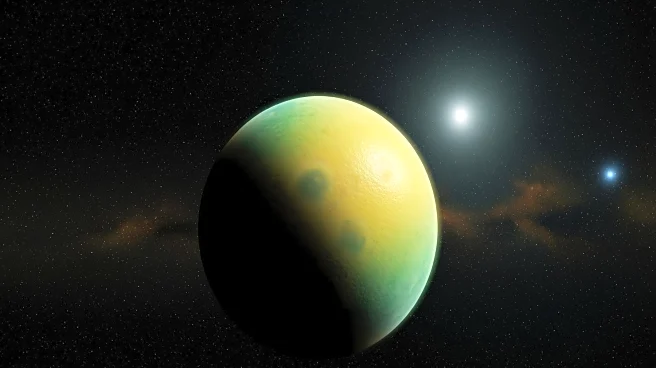
Astronomers utilizing the James Webb Space Telescope have identified an extraordinary exoplanet, PSR J2322-2650b, which challenges existing understandings of planetary formations. This planet, similar
in mass to Jupiter, orbits a pulsar at a mere one million miles away, resulting in its oblong, lemon-like shape due to the intense gravitational pull. The planet completes its orbit in just 7.8 Earth hours. The findings, published in The Astrophysical Journal Letters, suggest that this planet might represent a new class of cosmic objects. The planet's atmosphere, dominated by helium and carbon, reaches temperatures up to 3,700 degrees Fahrenheit, leading to unique weather patterns, including carbon soot clouds that may condense into diamond shards near the core.
Why It's Important?
The discovery of PSR J2322-2650b is significant as it expands the understanding of planetary diversity and formation. The planet's unique characteristics, such as its shape and atmospheric composition, challenge existing models of planetary science. This could lead to new insights into the processes that govern planet formation and evolution, particularly in extreme environments. The study of such unusual exoplanets can also enhance the understanding of pulsar systems and their potential to host planets, which was previously considered rare. This discovery may prompt further research into similar systems, potentially uncovering more planets with unconventional features.
What's Next?
Future research will likely focus on further observations of PSR J2322-2650b to understand its formation and evolution. Scientists may explore whether this planet is a remnant of a larger stellar object or represents a new type of celestial body. The James Webb Space Telescope and other observatories will continue to monitor similar systems to identify more planets with unique characteristics. This could lead to the development of new theoretical models to explain the formation of such planets. Additionally, the study may inspire the search for other pulsar-hosted planets, expanding the catalog of known exoplanets.
Beyond the Headlines
The discovery of PSR J2322-2650b raises questions about the potential for other unknown types of celestial bodies in the universe. The planet's unusual composition and formation challenge existing theories, suggesting that there may be other mechanisms at play in the universe that are not yet understood. This could lead to a reevaluation of the criteria used to classify planets and other celestial objects. The study also highlights the importance of advanced telescopes like the James Webb in uncovering new astronomical phenomena, emphasizing the need for continued investment in space exploration and research.