

What's Happening?
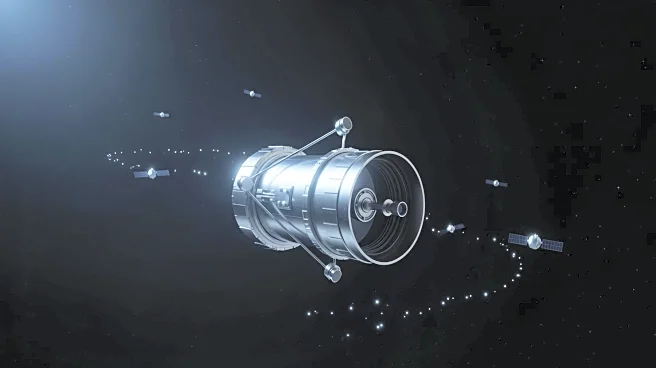
A NASA-led study has raised concerns about the increasing number of satellites in low-Earth orbit, which are causing significant light pollution affecting space telescopes like the Hubble Space Telescope. The study, published in Nature, indicates that
light reflected or emitted by these satellites could contaminate a substantial portion of images taken by major space observatories over the next decade. The research examined four observatories, including NASA's Hubble and SPHEREx, and two planned missions by the European Space Agency and China. Simulations suggest that around 40% of Hubble images and nearly 96% of images from the other observatories could be affected by satellite streaks. This interference is primarily due to the satellites' solar panels reflecting sunlight, as well as light from the Moon and Earth. The study highlights the rapid increase in satellite numbers, with projections estimating up to 560,000 satellites in orbit by the 2030s.
Why It's Important?
The findings of this study have significant implications for astronomical research and the future of space observation. The contamination of telescope images by satellite streaks could lead to the loss of valuable scientific data, making it more challenging to study faint celestial objects and phenomena. This issue is particularly concerning for the detection of potentially hazardous asteroids, as satellite trails can mimic the appearance of these objects. The study underscores the need for careful consideration of satellite deployment to balance the benefits of global telecommunications with the preservation of astronomical research capabilities. As satellite numbers continue to rise, the scientific community may face increased challenges in conducting space-based observations, potentially hindering advancements in our understanding of the universe.
What's Next?
The study suggests that the most direct response to mitigate the impact of satellite swarms would be to limit the number of satellites launched. However, the growing demand for global communication and data capacity presents a challenge to this approach. As new competitors enter the market, the number of satellites is expected to increase, potentially exacerbating the issue. The scientific community may need to explore alternative solutions, such as developing new technologies or strategies to filter out satellite interference in telescope images. Additionally, collaboration between space agencies, satellite operators, and policymakers will be crucial in addressing this emerging challenge and ensuring the continued success of space-based astronomical research.