



What's Happening?
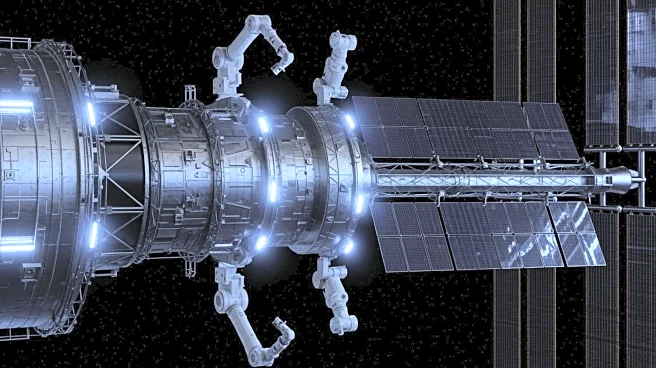
NASA astronauts Mike Fincke and Zena Cardman are set to conduct the first spacewalk of 2026 from the International Space Station (ISS) on Thursday. The primary objective of this six-and-a-half-hour spacewalk is to install a modification kit and route
cables for a future roll-out solar array, which is part of ongoing efforts to upgrade the station's power systems. Secondary tasks include installing jumper cables, taking hardware photos, and collecting microorganism samples. The spacewalk is scheduled to begin at 8 a.m. EST, with live coverage starting at 6:30 a.m. on NASA+, Amazon Prime, and YouTube. The astronauts have been preparing by organizing tools, configuring spacesuits, and reviewing procedures with mission controllers. They will be assisted by Flight Engineers Chris Williams and Kimiya Yui, who will help with spacesuit operations and monitor the spacewalk.
Why It's Important?
This spacewalk is crucial for maintaining and enhancing the ISS's power capabilities, which are vital for supporting scientific research and daily operations aboard the station. The installation of new solar arrays will ensure a more efficient power supply, enabling the ISS to continue its role as a hub for international scientific collaboration. The research conducted on the ISS, including studies in physics, microbiology, and artificial intelligence, has significant implications for advancements in space technology and potential applications on Earth. The success of this mission could lead to improved spacecraft designs and advanced storage systems, benefiting future space exploration missions and terrestrial technologies.
What's Next?
Following the spacewalk, the astronauts will continue their research and maintenance activities aboard the ISS. The installation of the solar array modification kit is a preparatory step for future upgrades, indicating ongoing efforts to enhance the station's infrastructure. The crew will also engage in Earth observation sessions and other scientific experiments, contributing to a broader understanding of space and its potential benefits for humanity. As the ISS continues to serve as a platform for international cooperation, future missions will likely focus on further technological advancements and exploration initiatives.