
What's Happening?
Photographer Eric Lusito has embarked on a journey across the former Soviet Union to capture the remnants of vast scientific sites for his new book, 'Soviet Scientific Institutes.' These sites, once bustling
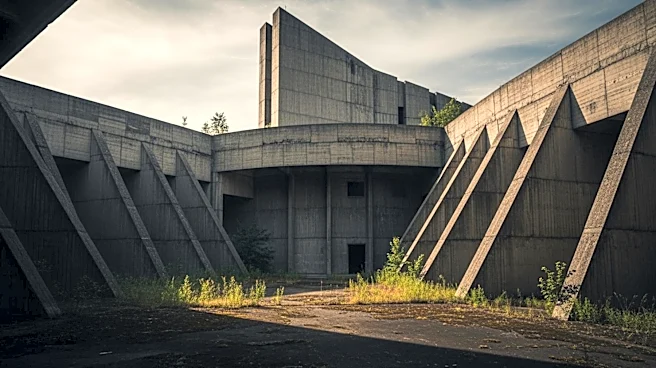
with scientific activity, have been largely abandoned since the fall of the Soviet Union. Lusito's exploration began in Ukraine in late 2021, prior to the Russian invasion, and continued across various locations, including Armenia and Kazakhstan. His photographs reveal the mysterious beauty and historical significance of these megastructures, some of which were designed to replace religious objects of worship. While many sites are in disrepair, others remain beautifully preserved, such as the control room for the Orgov Radio-Optical Telescope in Armenia. Lusito's work highlights the evolution and challenges faced by these scientific institutions, including battles against Moscow's scientific administrators to maintain their operations.
Why It's Important?
Lusito's documentation of these former Soviet scientific sites provides a unique insight into the historical and cultural significance of scientific endeavors during the Soviet era. These megastructures represent a period when science was heavily intertwined with state ideology, aiming to replace religious worship with scientific progress. The preservation and decay of these sites reflect the broader socio-political changes that have occurred since the Soviet Union's collapse. By capturing these images, Lusito contributes to the understanding of how scientific institutions have evolved and the impact of geopolitical shifts on scientific research. This work also serves as a reminder of the importance of preserving historical sites for future generations, offering a glimpse into the past and the potential for future scientific advancements.