



What's Happening?
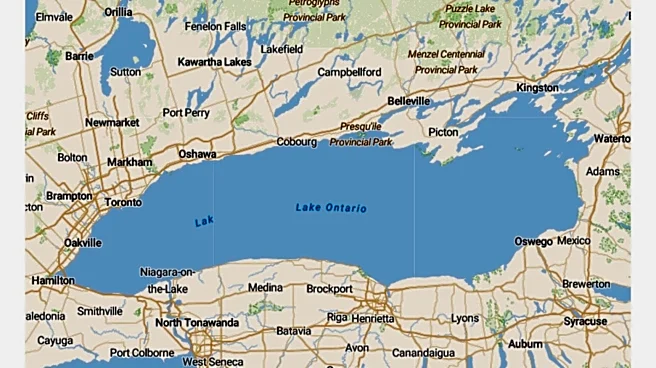
President Trump's executive order to rename Lake Ontario as 'Lake America' on U.S. federal government platforms has brought to light Canada's significant reliance on U.S. technology companies like Google and Apple. Google has already implemented this
change for U.S. users, offering an option for non-American websites to display 'Lake Ontario' by localizing their maps to Canada. U.S. Interior Secretary Doug Burgum confirmed that President Trump has also contacted Apple with the same request for its applications. This move follows an increasingly bitter trade dispute between the U.S. and Canada. Tech industry experts, such as Anne Pasek, Canada Research Chair in Media, Culture and the Environment at Trent University, emphasize that Canadian consumers and businesses are largely 'locked in' to these U.S.-owned platforms due to a lack of viable non-American alternatives. This reliance extends beyond navigation to critical services like e-commerce, rideshare, and food delivery apps, which integrate U.S. mapping tools for various functionalities.
Why It's Important?
This situation is important because it exposes a critical vulnerability in Canada's digital infrastructure and highlights the broader implications of technological dependence on a single foreign power, especially amidst strained political relations. The renaming of a shared natural landmark, even if primarily for U.S. users, symbolizes a potential assertion of digital sovereignty and could be perceived as a provocative act in the ongoing trade war. For Canadian businesses, this reliance means that their operations, from customer service to logistics, are deeply intertwined with U.S. tech giants. Any disruption or policy change by these U.S. companies, potentially influenced by government directives, could have significant economic repercussions for Canada. The lack of homegrown alternatives or diverse international options creates a 'choke point,' as noted by Emily Osborne of the Canadian Shield Institute, making Canada susceptible to digital leverage in political or economic disputes. This scenario underscores the need for Canada to develop its own digital infrastructure and foster domestic tech solutions to safeguard its economic and national security interests.
What's Next?
The immediate next steps involve observing Apple's response to President Trump's request to rename Lake Ontario on its apps. Should Apple comply, it would further solidify the U.S. administration's initiative and potentially increase pressure on other tech companies. Canadian businesses and government entities that rely on U.S. mapping APIs will need to continue adjusting their settings to ensure accurate geographical representation for Canadian users. Experts like Emily Osborne suggest that if U.S.-Canada tensions persist, the Trump administration might explore other tech-related 'choke points,' such as payment processing or cloud storage, to exert pressure on Canada. This could lead to Canadian policymakers prioritizing investments in domestic digital infrastructure and exploring partnerships with non-U.S. tech providers to reduce dependency. The broader conversation around digital sovereignty and the control of critical online services will likely gain momentum in Canada, potentially leading to new policies aimed at fostering a more resilient and independent digital ecosystem.
Beyond the Headlines
Beyond the immediate political and economic implications, the 'Lake America' incident raises profound questions about digital cartography, national identity, and the power of technology companies to shape perception. The act of renaming a shared geographical feature, even within a digital context, touches upon historical and cultural sensitivities. It highlights how digital platforms, often perceived as neutral tools, can become instruments of national policy or political messaging. This event could trigger a broader re-evaluation in Canada, and potentially other nations, about the governance of digital spaces and the need for greater control over data and digital representations of national assets. The incident also underscores the ethical responsibilities of global tech companies to navigate geopolitical sensitivities and maintain neutrality, or at least transparency, in their operations. The long-term shift could involve a global push for more localized and sovereign digital infrastructures, reducing the dominance of a few large, often U.S.-based, tech corporations.