



What's Happening?
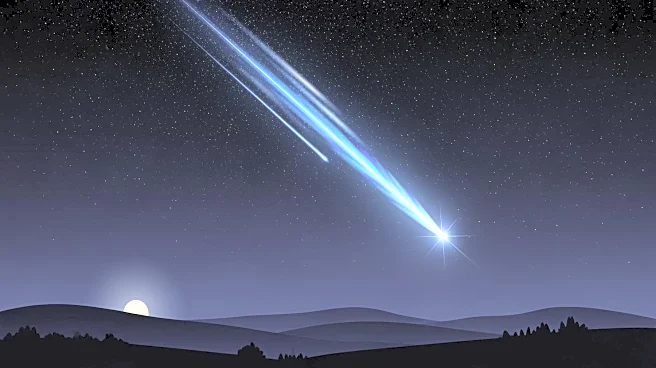
In December 2025, stargazers in the Northern Hemisphere will have the opportunity to witness two significant meteor showers: the Geminids and the Ursids. The Geminid meteor shower, which is considered one of the best meteor showers due to its bright and plentiful
meteors, will be visible from December 4 to 20, peaking on the night of December 13-14. The Geminids are unique as they originate from an asteroid, 3200 Phaethon, rather than a comet. During peak times, observers can expect to see up to 120 meteors per hour. Following the Geminids, the Ursid meteor shower will occur from December 17 to 26, peaking on the night of December 21-22. The Ursids, which are less intense than the Geminids, originate from the Comet 8P/Tuttle. Both meteor showers are best viewed in areas with minimal light pollution.
Why It's Important?
Meteor showers like the Geminids and Ursids offer a spectacular natural display and are significant for both amateur and professional astronomers. They provide an opportunity to study the composition and behavior of meteors as they enter Earth's atmosphere. The Geminids, in particular, are notable for their brightness and frequency, making them an excellent subject for scientific observation and public engagement in astronomy. These events also highlight the importance of preserving dark skies, as light pollution can significantly diminish the visibility of such celestial phenomena. For the general public, meteor showers are a chance to connect with the natural world and inspire interest in space science.
What's Next?
As the peak dates for the Geminid and Ursid meteor showers approach, astronomers and enthusiasts will prepare for optimal viewing conditions. This includes finding locations with minimal light pollution and clear skies. Educational institutions and observatories may organize public viewing events to engage communities and promote interest in astronomy. Additionally, scientists will continue to monitor these meteor showers to gather data on their origins and characteristics, contributing to our understanding of the solar system.