


What's Happening?
The White House launched a personal attack against CNN reporter Kristen Holmes via social media after she questioned President Trump about comments made by Democratic Senator Jon Ossoff. Senator Ossoff had suggested that President Trump was more interested
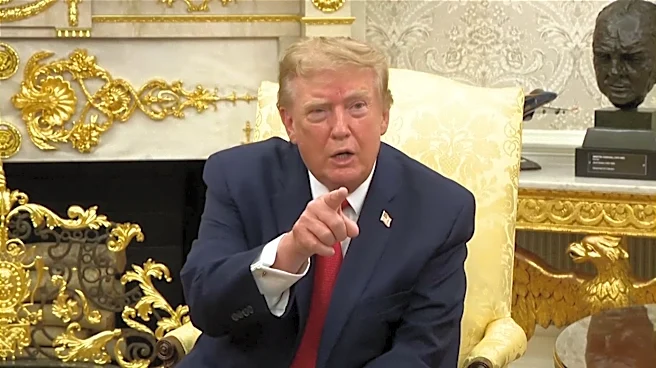
in personal endeavors than his presidential duties, specifically mentioning his executive assistant, Natalie Harp. During an Oval Office event, Holmes asked President Trump to respond to these remarks. In response, President Trump dismissed Ossoff as a 'Pee-wee Herman lookalike' and directly criticized Holmes, telling her to 'be quiet' and calling her 'disrespectful,' 'fake news,' and a 'loud boisterous person.' The White House's 'rapid response' social media account subsequently posted a clip of the exchange, labeling Holmes a 'disgraceful, humiliating embarrassment' and accusing her of asking a 'disgusting and inhumane question' that mentioned her children.
Why It's Important?
This incident highlights ongoing tensions between the White House and certain media outlets, particularly CNN, and raises significant concerns about press freedom and the treatment of journalists covering the U.S. presidency. The White House's use of social media to personally attack a reporter, including references to her children, is seen by many as an attempt to intimidate the press and discourage critical questioning. CNN defended Holmes, stating that she asked a 'tough, relevant, and newsworthy question' and that personal attacks on journalists are 'beneath the office and inconsistent with the principles of a free press.' Such actions can have a chilling effect on reporting, potentially leading journalists to self-censor to avoid similar public condemnation. This dynamic impacts the public's access to unfiltered information and the ability of the press to hold powerful figures accountable, which are foundational elements of a democratic society.
What's Next?
The confrontation is likely to intensify the debate surrounding media relations with the White House and the role of journalists in a politically charged environment. CNN and other journalistic organizations are expected to continue defending their reporters and advocating for press freedom, potentially leading to further public statements or internal policy discussions on how to navigate such interactions. The incident may also prompt renewed scrutiny from media watchdogs and civil liberties groups regarding the administration's approach to the press. For the White House, this strategy of direct confrontation with journalists is likely to continue, especially as political campaigns and public discourse become increasingly polarized. The broader implication is a continued erosion of trust between political institutions and the media, making it more challenging for the public to discern objective information.
Beyond the Headlines
Beyond the immediate political skirmish, this event underscores a deeper cultural and ethical challenge regarding public discourse and the respect for professional roles. The personal nature of the attacks, particularly the mention of a reporter's children, crosses a line that many consider unacceptable in professional interactions, regardless of political affiliation. This tactic can normalize aggressive behavior towards individuals performing their professional duties, potentially leading to a broader societal acceptance of such conduct. It also raises questions about the ethical boundaries of social media use by government entities and the impact of such platforms on public perception of journalism. The long-term consequence could be a further polarization of media consumption, where audiences increasingly seek out news that confirms their existing biases, rather than engaging with diverse perspectives, thereby fragmenting the public sphere and hindering constructive dialogue.