
What's Happening?
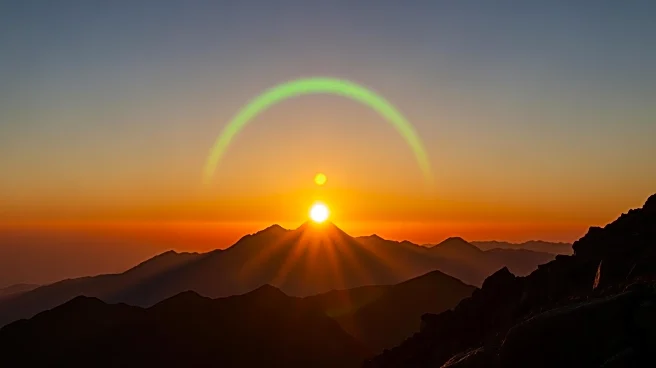
A photograph taken from Cerro Pachón in the Chilean Andes captures the elusive green flash phenomenon during sunset. The green flash occurs when sunlight is bent and split by Earth's atmosphere, creating
a brief green rim at the top edge of the sun. This atmospheric trick is caused by the refraction of light, where shorter wavelengths like blue and green are bent more strongly than red and orange. The green flash is typically visible for only a second or two, making it difficult to observe without sensitive cameras and high-quality lenses.
Why It's Important?
The green flash provides valuable insights into atmospheric optics and the vertical structure of the atmosphere near the horizon. By modeling and measuring green flashes, scientists can test their understanding of how temperature, pressure, and density vary with altitude. This knowledge is crucial for improving the accuracy of astronomical observations and sharpening images and spectra of distant stars and galaxies. Instruments like atmospheric dispersion correctors are designed to counteract the effects of atmospheric bending, enhancing the quality of astronomical data.