


What's Happening?
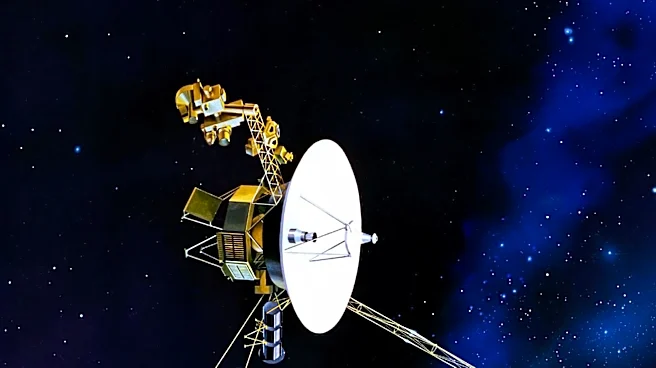
In 1977, NASA's Voyager 1 probe, now venturing into interstellar space, carried a Golden Record intended to communicate humanity's story to potential extraterrestrial civilizations. This record, curated by astronomer Carl Sagan, included 116 images, sounds,
music, and greetings. Among the images considered, a photograph depicting a naked man and a naked pregnant woman was initially selected to illustrate human reproduction. However, at the last moment before launch, NASA prohibited this image. This decision was influenced by previous controversies surrounding naked human silhouettes on the Pioneer 10 and 11 probes. As a compromise, a stylized outline of a couple with a fetus was used instead of the photograph, reflecting a tension between scientific accuracy and societal modesty.
Why It's Important?
This historical anecdote reveals the complex interplay between scientific endeavors, public perception, and cultural norms within the U.S. context, even when communicating with hypothetical extraterrestrial life. The censorship of the photograph highlights the sensitivity surrounding the representation of the human body and sexuality in the 1970s, demonstrating how societal values can influence scientific missions. It underscores the challenges faced by institutions like NASA in balancing scientific integrity with the need to avoid public controversy. The incident also provides insight into the decision-making processes behind significant cultural artifacts, as the Golden Record was intended to be a lasting representation of humanity. The compromise ultimately chosen—a sketch over a photograph—reflects a broader societal tendency to sanitize or abstract potentially provocative imagery.
What's Next?
The Voyager 1 and 2 probes continue their journey through interstellar space, carrying their message with its inherent compromises. Voyager 1 is expected to pass near the star Gliese 445 in about 40,000 years, and Voyager 2 will approach Ross 248. While the likelihood of the Golden Record being intercepted and understood by extraterrestrial intelligence remains extremely low, its legacy continues to be debated and analyzed. Future deep-space missions designed for interstellar communication will likely draw lessons from the Voyager experience, considering how to represent humanity in a way that is both scientifically accurate and culturally sensitive. This historical event serves as a reminder for future endeavors to anticipate and navigate potential societal reactions to scientific and cultural representations.
Beyond the Headlines
The censorship of the Voyager image delves into deeper philosophical and ethical questions about how humanity chooses to represent itself to the unknown. It exposes the inherent biases and cultural filters through which we interpret and present our own existence. The paradox that more anatomically detailed drawings by Jon Lomberg, depicting vertebrate evolution, were included without issue, while a photograph of human reproduction was deemed too explicit, highlights the nuanced and often inconsistent boundaries of what is considered acceptable. This incident reflects a persistent tension between scientific realism and cultural comfort, suggesting that even in the grandest scientific endeavors, human societal norms and anxieties play a significant role. It prompts reflection on what aspects of humanity we prioritize for external representation and how these choices reflect our internal values and self-perceptions.