




What's Happening?
Hawaii operates with only five counties: Hawaii, Maui, Kauai, Oahu, and Kalawao, a structure established in 1905, decades before its statehood in 1959. This limited number of counties is a direct result of Hawaii's unique historical development, which
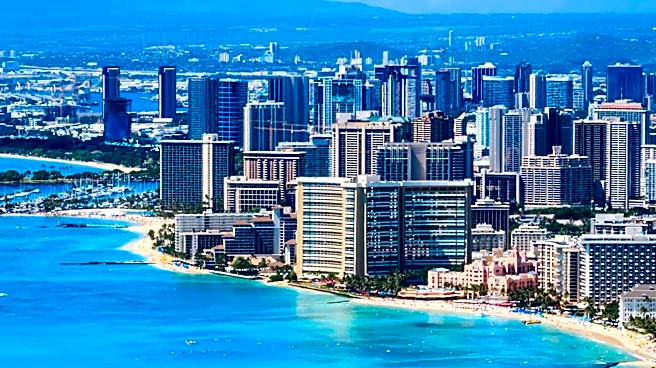
includes its past as an independent kingdom and its territorial period under the United States. Unlike most U.S. states, Hawaii does not have separate incorporated towns or cities; instead, county governments handle most municipal services. For example, the City and County of Honolulu consolidates city and county functions for Oahu. The county boundaries largely align with the major islands or groups of islands, a practical approach given the archipelago's geography. Kalawao County, located on the Kalaupapa Peninsula of Molokai, is particularly unique, having been established as a settlement for individuals with Hansen's disease and remaining under the jurisdiction of the Hawaii Department of Health rather than having an elected government.
Why It's Important?
Hawaii's distinct county system significantly impacts local governance and public service delivery. By consolidating municipal functions at the county level, the state streamlines administration and resource allocation, avoiding the complexities of multiple layers of local government found elsewhere in the U.S. This structure means that services like police, fire protection, roads, and waste management are managed by a smaller number of larger entities, which can lead to efficiencies but also requires broad county-level planning. The historical roots of this system, stemming from the Hawaiian Kingdom's land divisions and subsequent territorial organization, underscore the state's unique political evolution. The case of Kalawao County highlights a historical public health policy that continues to influence administrative divisions, demonstrating how past events shape contemporary governance structures.
What's Next?
The established five-county system in Hawaii is deeply ingrained and unlikely to undergo significant changes in the near future. The current structure has proven effective in managing the state's unique geography and population distribution. Future developments will likely focus on how these existing county governments adapt to challenges such as population growth, climate change impacts, and economic shifts within their established jurisdictions. Discussions may arise regarding resource allocation among the counties or the efficiency of service delivery, but the fundamental framework of five counties is expected to remain. The unique administrative status of Kalawao County will also likely persist, given its historical significance and ongoing management by the Department of Health.
Beyond the Headlines
Hawaii's county system offers a compelling case study in administrative efficiency and historical continuity. The absence of numerous incorporated cities challenges the conventional American model of local governance, suggesting that a more consolidated approach can be effective, especially in geographically distinct regions. This structure reflects a pragmatic adaptation to the island environment, where inter-island travel is primarily by air or sea, making island-wide governance more logical than fragmented municipal divisions. Furthermore, the enduring legacy of the Hawaiian Kingdom's land management practices, which influenced the territorial county formations, illustrates how pre-colonial administrative systems can leave lasting imprints on modern political geography. The unique status of Kalawao County serves as a poignant reminder of historical public health crises and the long-term administrative solutions implemented to address them, offering insights into the intersection of public health, governance, and historical memory.