


What's Happening?
Researchers from the University of Hong Kong (HKU) and the University of California, Los Angeles (UCLA) have uncovered the mechanism that powers the electric fields responsible for auroral displays. The study, published in Nature Communications, reveals
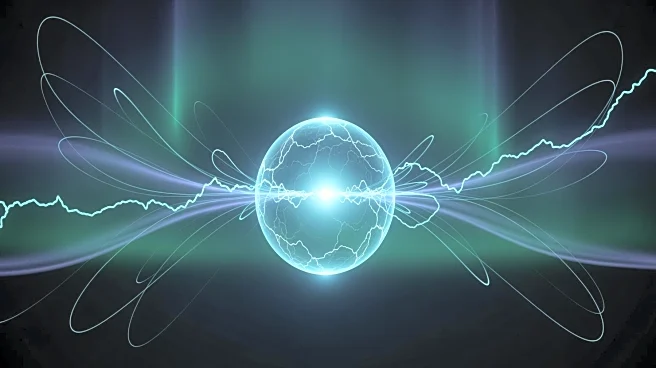
that Alfvén waves, which are plasma waves traveling along Earth's magnetic field lines, act as a natural power source. These waves accelerate charged particles into the atmosphere, creating the aurora's glowing lights. The research team analyzed data from multiple satellites, including NASA's Van Allen Probes and the THEMIS mission, to confirm that Alfvén waves continuously transfer energy to the auroral acceleration region. This discovery not only explains the physics behind Earth's auroras but also provides a model applicable to other planets.
Why It's Important?
The findings have significant implications for understanding planetary auroras beyond Earth. By identifying Alfvén waves as a universal mechanism, the research offers insights into the magnetospheric dynamics of other planets, such as Jupiter and Saturn. This knowledge enhances our understanding of space weather phenomena, which can impact satellite operations and communication systems on Earth. The interdisciplinary collaboration between HKU and UCLA highlights the importance of combining expertise in Earth and planetary sciences to address complex scientific questions. The study's results could inform future space missions and contribute to the development of technologies that mitigate the effects of space weather on human activities.
What's Next?
The research opens avenues for further exploration of auroral processes on other planets, potentially leading to new discoveries in planetary science. Future studies may focus on applying the findings to different celestial bodies, enhancing our understanding of their magnetic environments. Additionally, the collaboration between HKU and UCLA sets a precedent for international scientific partnerships, encouraging more joint efforts in space research. As scientists continue to investigate the implications of Alfvén waves, there may be opportunities to develop predictive models for space weather, improving our ability to protect technological infrastructure from its adverse effects.
Beyond the Headlines
The study underscores the importance of interdisciplinary research in advancing scientific knowledge. By bridging the gap between Earth science and planetary exploration, the researchers have demonstrated the value of integrating different scientific perspectives. The discovery of Alfvén waves as a power source for auroras also raises questions about the potential for similar mechanisms in other astrophysical phenomena. As the scientific community delves deeper into these processes, there may be broader implications for our understanding of the universe and the fundamental forces that govern it.