


What's Happening?
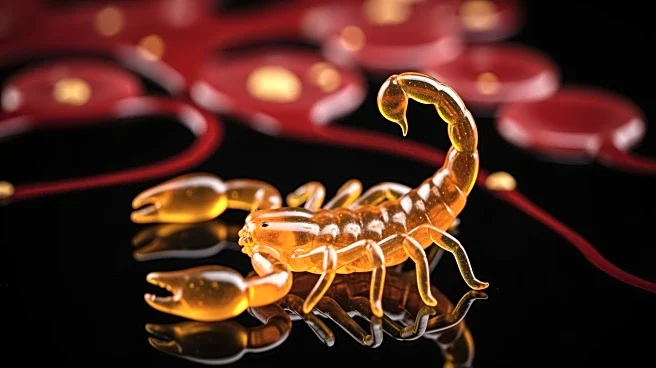
Researchers from the University of Queensland have discovered that the venom of the Androctonus scorpion, found in the Middle East and North Africa, can accelerate blood clotting. This finding, published in the journal Biochimie, highlights the venom's
ability to activate major clotting factors in human blood, specifically Factors VII and X, with the process relying on Factor V in its activated form. The study, led by Professor Bryan Fry and Ph.D. candidate Sam Campbell, demonstrated that while the venom's neurotoxic effects are neutralized by existing antivenoms, these treatments do not prevent the venom's procoagulant activity. The research suggests that small-molecule metalloprotease inhibitors, such as marimastat and prinomastat, can neutralize this clotting effect, offering a potential new avenue for medical treatment.
Why It's Important?
The discovery of the procoagulant properties of Androctonus scorpion venom could have significant implications for medical science, particularly in the development of new treatments for blood disorders. The ability to control blood clotting is crucial in various medical scenarios, including surgeries and trauma care. The study's findings suggest that the venom's unique biochemical properties could be harnessed to develop new diagnostic tools or treatments that manage blood loss more effectively. This research not only enhances the understanding of venom evolution but also opens up possibilities for drug discovery, potentially leading to innovative therapies that could save lives.
What's Next?
Future research will likely focus on further exploring the biochemical pathways involved in the venom's clotting mechanism and testing the efficacy of the identified inhibitors in clinical settings. The potential for developing adjunct treatments that target venom enzymes, especially when traditional antivenoms are insufficient, could lead to more comprehensive care for scorpion sting victims. Additionally, the study's findings may inspire further investigation into other venomous species, potentially uncovering new medical applications for their biochemical properties.