








What's Happening?
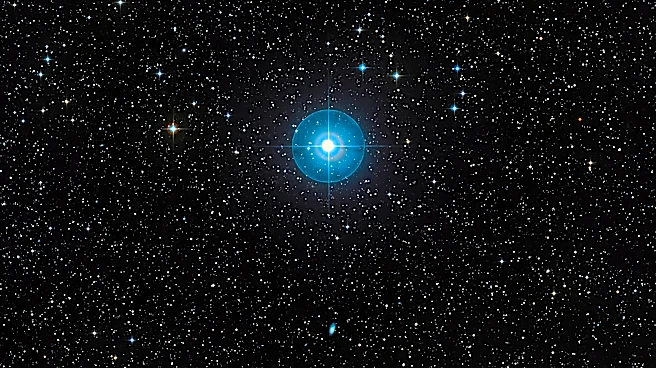
A newly confirmed rocky exoplanet, GJ 3378 b, located 25 light-years from Earth, has been identified as a potential candidate for extraterrestrial life. The planet orbits a cool red dwarf star, GJ 3378, and is situated within the habitable zone, receiving
about 90% of the radiation flux that Earth receives from the Sun. This positioning suggests a surface temperature similar to Earth's, which could allow for liquid water. However, the presence of an atmosphere remains uncertain due to the intense stellar winds and flares typical of red dwarfs, which could strip away atmospheric layers. The planet's proximity to its star results in one side being in perpetual daylight while the other remains in darkness. Future missions, such as NASA's planned Habitable Worlds Observatory, may provide definitive evidence of an atmosphere and potential biosignatures.
Why It's Important?
The discovery of GJ 3378 b is significant as it adds to the list of potentially habitable exoplanets, which are crucial in the search for extraterrestrial life. The planet's location within the habitable zone and its Earth-like surface temperature make it a prime candidate for further study. Understanding whether GJ 3378 b has an atmosphere is vital, as it could support liquid water, a key ingredient for life. This discovery also highlights the challenges posed by red dwarf stars, whose violent flares can threaten the habitability of nearby planets. The findings could influence future space exploration missions and the search for life beyond Earth, potentially guiding the development of new technologies and observational strategies.
What's Next?
The next steps involve direct-imaging missions to confirm the presence of an atmosphere on GJ 3378 b. NASA's Habitable Worlds Observatory is expected to play a crucial role in this endeavor. If an atmosphere is detected, it could lead to further investigations into the planet's potential to support life. Additionally, the study of GJ 3378 b may inform the selection of targets for future interstellar exploration missions. The scientific community will likely focus on developing methods to overcome the challenges posed by red dwarf stars, such as atmospheric stripping, to better assess the habitability of similar exoplanets.
Beyond the Headlines
The discovery of GJ 3378 b raises broader questions about the long-term survival of humanity and the potential for interstellar migration. As the Sun is expected to become uninhabitable in about a billion years, exoplanets like GJ 3378 b could serve as future homes for humanity. The concept of interstellar real estate, where location is paramount, underscores the importance of identifying and preserving habitable planets. This discovery also emphasizes the need for continued investment in space exploration and technology to ensure the survival of human civilization in the distant future.