



What's Happening?
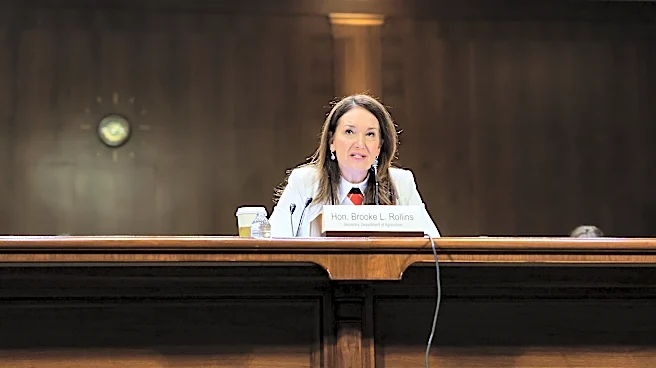
In February 2026, U.S. Department of Agriculture (USDA) Secretary Brooke Rollins announced the Farmer and Rancher Freedom Framework. This initiative officially recognizes and aims to address 'agricultural lawfare,' defined as the use of administrative,
legal, and legislative government systems to negatively impact farmers, ranchers, and agricultural producers. The USDA has established an online platform for agricultural producers to report instances of alleged lawfare. This development signifies the USDA's acknowledgment that the legal system itself can impose significant costs and challenges on agricultural businesses, making legal risk a critical concern alongside traditional risks like weather and commodity prices. The framework highlights how litigation, enforcement actions, and regulatory uncertainty can severely affect the economic viability of farming operations.
Why It's Important?
The introduction of the Farmer and Rancher Freedom Framework is important because it formally recognizes the growing burden of legal and regulatory challenges on the U.S. agricultural sector. Farmers and ranchers, who are inherently tied to their land, face unique vulnerabilities to 'lawfare,' as they cannot easily relocate their operations to avoid legal disputes. This framework underscores how legal actions, even if ultimately unsuccessful for the plaintiffs, can lead to substantial economic losses, delays, and uncertainty for producers. It also suggests a shift in how the USDA views its role, moving beyond traditional support to actively protect producers from what it identifies as weaponized legal processes. This could lead to new policies and protections designed to safeguard the livelihoods of American farmers and ranchers against potentially debilitating legal battles.
What's Next?
The USDA's new online mechanism for reporting 'agricultural lawfare' suggests a proactive approach to gathering data and understanding the scope of the problem. This data could inform future policy decisions, legislative proposals, or enforcement priorities aimed at mitigating legal risks for agricultural producers. The framework may also lead to increased legal support or educational resources for farmers and ranchers to navigate complex regulatory environments and litigation. Furthermore, the initiative could spark broader discussions about the role of the judiciary and administrative agencies in regulating agriculture, potentially influencing how courts interpret statutes and how agencies implement regulations. The long-term impact will depend on the effectiveness of the reporting mechanism and the subsequent actions taken by the USDA and other governmental bodies.
Beyond the Headlines
The concept of 'agricultural lawfare' raises deeper questions about the balance of power between government agencies, environmental groups, and individual landowners. It highlights how legal and administrative processes, intended to ensure compliance and protect public interests, can inadvertently become tools that threaten the economic stability of a vital industry. This initiative could prompt a re-evaluation of existing legal frameworks and regulatory interpretations, particularly in areas like environmental law and land use, to ensure they do not disproportionately burden agricultural producers. It also touches upon the ethical implications of using legal means to achieve policy objectives, especially when such actions can lead to severe financial distress for those targeted. The framework implicitly acknowledges that the 'least dangerous' branch of government, the judiciary, can become a significant regulatory force through its interpretations and rulings, impacting the very fabric of American agriculture.