








What's Happening?
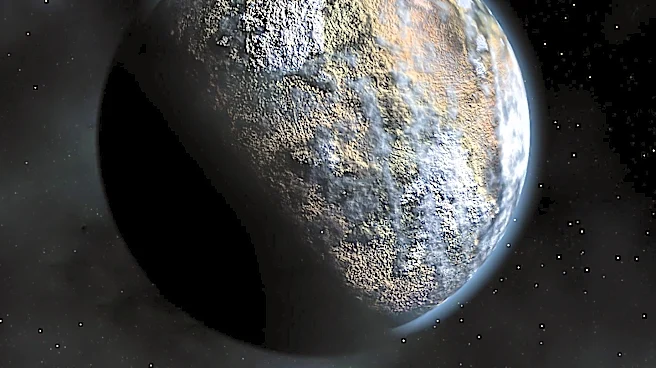
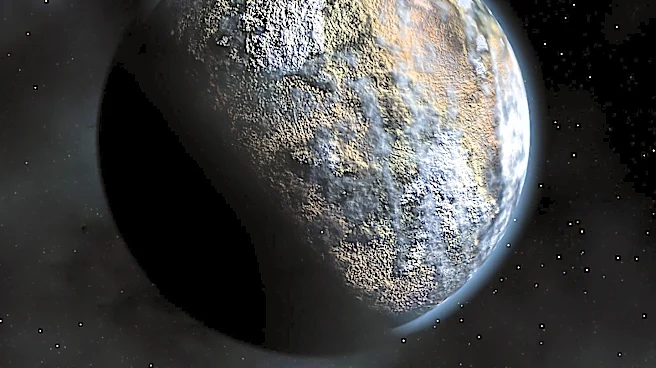
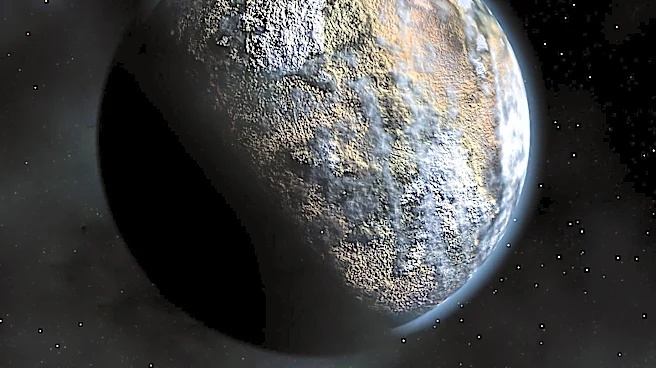
An international team of astronomers has made a groundbreaking discovery by detecting an atmosphere on the rocky exoplanet LHS 1140 b, located 48 light-years away from Earth. This planet, classified as a 'super-Earth,' is situated in the habitable zone
of its star, a region where conditions may allow for liquid water. The detection was made using the WINERED spectrograph on the Magellan Clay telescope in Chile, which identified helium escaping from the planet's atmosphere during a stellar transit. LHS 1140 b, discovered in 2017, has a mass 5.6 times that of Earth and a radius 70% larger, orbiting a cool red dwarf star every 24.7 days. This discovery marks the first time an atmosphere has been detected on a rocky planet in a habitable zone, offering new insights into the potential for life-supporting conditions beyond our solar system.
Why It's Important?
The discovery of an atmosphere on LHS 1140 b is a significant milestone in the search for extraterrestrial life. It provides the first direct evidence that rocky planets in habitable zones can retain atmospheres, a crucial factor for supporting life. This finding expands our understanding of planetary atmospheres and their evolution, suggesting that conditions conducive to life might be more common than previously thought. The presence of an atmosphere on a super-Earth raises the possibility of discovering more planets with similar characteristics, potentially leading to the identification of life beyond Earth. This discovery also enhances our knowledge of how atmospheres form and evolve on planets outside our solar system, offering a new perspective on the diversity of planetary systems in the galaxy.
What's Next?
Future observations and studies will focus on analyzing the composition of LHS 1140 b's atmosphere in greater detail to determine the presence of other gases that could support life. Researchers will continue to monitor the planet during stellar transits to gather more data on its atmospheric properties. The discovery also sets the stage for further exploration of other rocky planets in habitable zones, using advanced telescopes and spectrographs to search for signs of life. As technology advances, astronomers hope to identify more exoplanets with atmospheres, bringing us closer to answering the age-old question of whether we are alone in the universe.