







What's Happening?
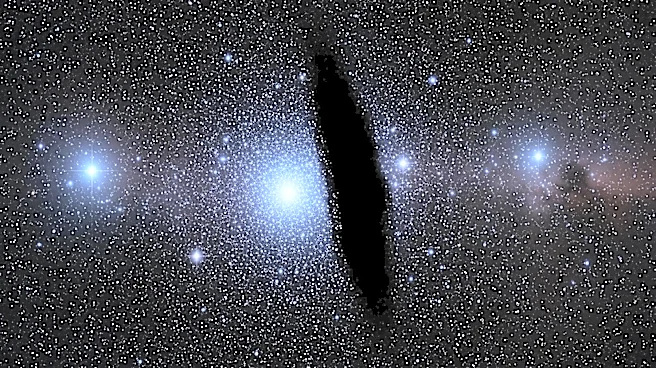
The European Space Agency's Euclid space telescope has discovered an unexpected anomaly in the star cluster NGC 6397, revealing a gap in the brightness distribution of its stars. This finding challenges existing theories about stellar evolution in dense
star systems. The anomaly specifically affects red dwarf stars, which are the most common type of star in the Milky Way galaxy. Researchers found a missing range in brightness where certain red dwarf stars should appear, suggesting a rapid transition phase in their evolution. This discovery was made possible by combining data from Euclid with archival observations from the Hubble Space Telescope and the Gaia mission.
Why It's Important?
The discovery of a brightness gap in NGC 6397 provides new insights into the evolution of red dwarf stars, which are crucial for understanding stellar populations. This finding could lead to a revision of theoretical models of stellar evolution, particularly in dense environments like globular clusters. Understanding these processes is essential for astronomers to accurately model the life cycles of stars and the dynamics of star clusters. The use of combined data from multiple space telescopes highlights the importance of collaborative efforts in astronomy to uncover hidden patterns and anomalies that can advance our knowledge of the universe.
What's Next?
Researchers will continue to analyze the data from Euclid, Hubble, and Gaia to further investigate the causes of the brightness gap in NGC 6397. Future studies may focus on identifying similar anomalies in other star clusters to determine if this is a common phenomenon. The findings could lead to new research directions in stellar astrophysics and contribute to a deeper understanding of the mechanisms driving stellar evolution. Additionally, the ongoing analysis of data from large-scale sky surveys will likely reveal more hidden patterns and anomalies, providing further opportunities for discovery.