




What's Happening?
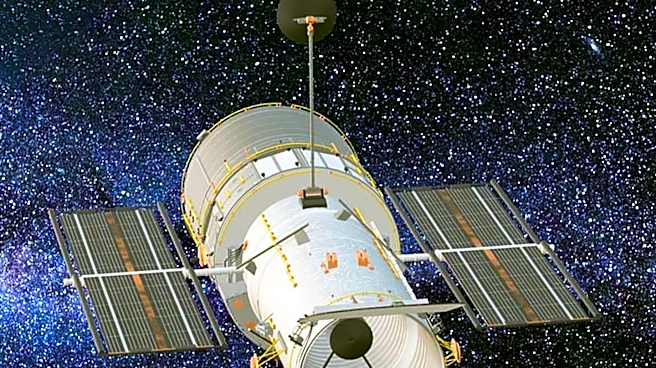
The Hubble Space Telescope has provided evidence of a significant collision and merger between our Milky Way galaxy and a dwarf galaxy, named LKH, approximately 11.8 billion years ago. This discovery, reported in the journal Nature Astronomy by lead author
Davide Massari, indicates that the Milky Way's early evolution was influenced by stars originating from external galaxies, challenging previous assumptions that its earliest phases were solely defined by stars born within the galaxy itself. Researchers identified a third population of globular clusters that are neither native to the Milky Way nor from the previously known Gaia–Sausage–Enceladus (GSE) merger, which occurred about 10 billion years ago. These newly identified clusters arrived before the GSE merger, suggesting an even earlier and impactful galactic event. The LKH dwarf galaxy is estimated to have had a total mass of 500 million times the mass of our sun, contributing a substantial amount of stars, gas, and dark matter to the then-smaller Milky Way.
Why It's Important?
This discovery significantly alters our understanding of the Milky Way's formation and evolution. Galactic mergers are a primary mechanism for galaxy growth, and identifying this ancient collision provides crucial insights into how our home galaxy developed its current structure and composition. The LKH merger likely spurred a fresh burst of star formation, contributing to the Milky Way's growth, and the chemical makeup of LKH's stars would have influenced the overall chemical evolution of our galaxy. This means that the building blocks of our galaxy are more diverse than previously thought, incorporating material from other celestial bodies from a very early stage. Understanding these ancient events helps astronomers refine models of galaxy formation and evolution across the universe, providing a more complete picture of cosmic history.
What's Next?
Future research will likely focus on further characterizing the LKH dwarf galaxy and its precise impact on the Milky Way. Astronomers will continue to analyze data from the Hubble Space Telescope and other observatories, such as the European Space Agency's Gaia mission, to identify more such ancient merger events. This ongoing detective work aims to piece together a more comprehensive timeline of the Milky Way's mergers and acquisitions, potentially uncovering other previously unknown galactic interactions. The findings will also inform theoretical models of galaxy evolution, leading to more accurate simulations of how galaxies grow and change over billions of years. The study of these ancient collisions could also shed light on the distribution of dark matter and the early conditions of star formation in the universe.
Beyond the Headlines
The revelation of the LKH merger underscores the dynamic and violent history of galaxies, including our own. It highlights that the universe is a constantly evolving system where celestial bodies interact and merge, shaping each other's destinies. This discovery also emphasizes the power of advanced astronomical instruments like the Hubble Space Telescope in unraveling cosmic mysteries that occurred billions of years ago. The concept that our galaxy is a composite of various smaller galaxies, each contributing its unique stellar populations and chemical elements, offers a profound perspective on our cosmic origins. It suggests that the stars, planets, and even the elements that make up life on Earth may have originated from multiple galactic sources, making our existence a product of a vast, interconnected cosmic history.