




What's Happening?
Lebanon's National Human Rights Commission, including the Committee for the Prevention of Torture, has published a study titled 'Climate Change and Human Rights in Lebanon: The Emerging Role of National Human Rights Institutions.' This release coincides
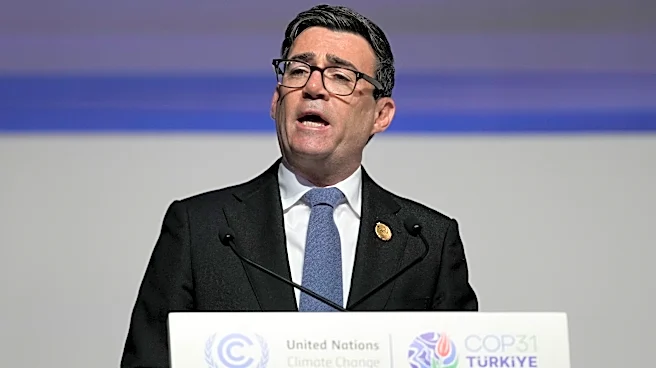
with the 31st United Nations Climate Change Conference (COP31) in Antalya, Turkey. The study investigates how climate commitments can be translated into effective protection of human rights within Lebanon, a country grappling with fragile public services, an economic crisis, and the consequences of conflict. It concludes that assessing climate action requires evaluating its impact on life, health, water, housing, and work, in addition to measuring emissions. The study proposes an approach that links legal obligations, responsible institutions, financing, and evidence of implementation to enable citizens to assess changes in services and decisions affecting their lives. Key findings include an existing legal framework for monitoring, recent climate plans with limited implementation data, and the need to connect emissions inventories and financing with clear results on how benefits and burdens are distributed across regions and population groups.
Why It's Important?
This study from Lebanon's National Human Rights Commission is crucial because it explicitly links climate action with human rights, a perspective often overlooked in broader climate discussions. In a country like Lebanon, where public services are severely strained and economic instability is rampant, the impacts of climate change directly threaten fundamental human rights such as access to water, health, and adequate living conditions. By proposing a framework that assesses climate action through a human rights lens, the study advocates for policies that prioritize the well-being of the most vulnerable populations. It highlights the necessity of transparent financing and clear accountability for climate initiatives, ensuring that international commitments translate into tangible improvements for citizens. This approach can serve as a model for other nations facing similar challenges, emphasizing that climate justice is an integral component of effective climate policy and sustainable development. The study's release at COP31 also underscores the global call for human rights to be central to climate decisions.
What's Next?
The study's recommendations call on the Council of Ministers and relevant ministries in Lebanon to establish a priority register for the Nationally Determined Contribution and National Adaptation Plan, clearly identifying responsibilities, resources, and deadlines. It prioritizes the continuity of water and healthcare services and heat protection arrangements for workers. The Commission proposes an initial one-year program to address the right to water and protection from extreme heat in three selected locations, involving qualitative interviews, verification visits, and technical reviews. The study also recommends integrating heat, water, and energy risks into the Committee for the Prevention of Torture's preventive visiting tools. The overall results of COP31 and their subsequent national implementation will be critical in determining the effectiveness of these proposed measures. The Commission will continue to monitor, advise, and handle complaints related to human rights in the context of climate change, advocating for policies that protect the most exposed regions and population groups.
Beyond the Headlines
The Lebanese study's emphasis on the intersection of climate change, human rights, and national instability reveals a deeper layer of vulnerability that many developing nations face. It highlights how existing crises, such as economic downturns and conflicts, exacerbate the impacts of climate change, making effective adaptation and mitigation even more challenging. The call for transparent financing and accountability mechanisms is not just about climate action but also about good governance and rebuilding public trust in institutions. By focusing on the distribution of benefits and burdens, the study touches upon issues of social equity and justice, suggesting that climate policies must be designed to reduce inequalities rather than perpetuate them. This holistic approach, integrating human rights into climate policy, could inspire a paradigm shift in how international climate aid is structured and delivered, ensuring that it genuinely serves the needs of affected communities and promotes long-term resilience.