
What's Happening?
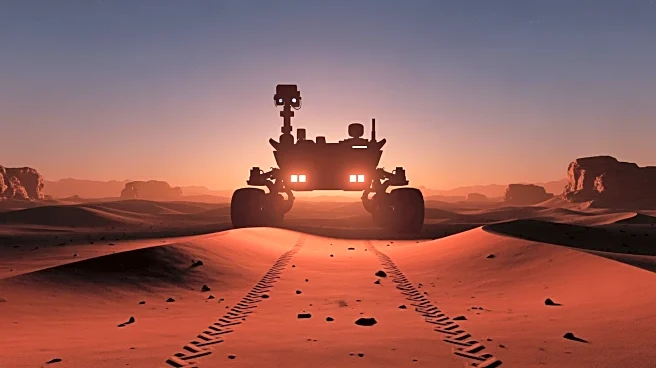
NASA's Perseverance Rover has successfully navigated 1,496 feet of the Martian surface using a route planned and executed by a generative AI model named Claude. This AI, developed by Anthropic, utilized imaging from the Mars Reconnaissance Orbiter and other
data to plot a safe path, avoiding potential hazards. The AI's involvement marks a significant step in automating complex planetary navigation, which traditionally requires careful planning by NASA's Jet Propulsion Laboratory (JPL) team due to the 20-minute communication delay between Earth and Mars. The AI's route was verified through rigorous simulations before being executed by the rover, demonstrating the potential for AI to enhance mission efficiency and scientific return.
Why It's Important?
The use of AI in navigating the Perseverance Rover on Mars represents a pivotal advancement in space exploration technology. By automating the navigation process, NASA can potentially increase the efficiency of its missions, allowing scientists to focus more on analyzing data and less on the logistics of rover movement. This development could lead to longer and more complex missions, enhancing our understanding of Mars and its potential for past life. The success of AI in this context also underscores the growing role of artificial intelligence in scientific research and exploration, potentially setting a precedent for future missions to other planets.
What's Next?
As NASA continues to refine AI-driven navigation, future missions may see even greater autonomy for rovers on Mars and beyond. The goal is to enable rovers to handle longer drives with minimal human intervention, allowing for more extensive exploration and data collection. This could lead to significant discoveries about Mars' geology and climate, and possibly even signs of past life. The integration of AI in space exploration may also inspire similar advancements in other fields, such as autonomous vehicles and robotics, further expanding the impact of this technology.