




What's Happening?
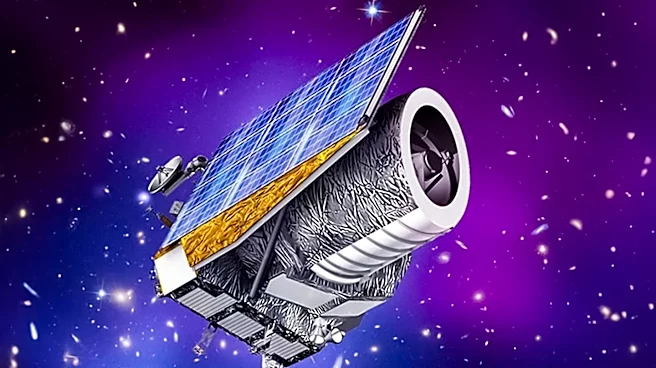
The new Nancy Grace Roman Space Telescope, launched in August, is currently undergoing commissioning and is anticipated to provide its first images to scientists and the public by mid-December. This powerful telescope is described as being '100x the scale
of Hubble,' indicating a significant leap in observational capability. Pasadena-based Patrick Lowrance, Caltech/IPAC Roman Science Support Center lead, and Bertrand Mennesson, NASA/JPL deputy project scientist, discussed the telescope's potential on the Blue Dot podcast. They highlighted that the Roman Space Telescope will open new views of the Universe, focusing on answering questions about dark energy and dark matter, and discovering numerous new exoplanets. The mission includes a Wide Field Imager and a Coronagraph Instrument, with the latter designed for high-contrast imaging of Jupiter-like planets around nearby stars.
Why It's Important?
The Nancy Grace Roman Space Telescope represents a pivotal advancement in space astronomy, promising to significantly expand our understanding of the Universe beyond what current telescopes like Hubble and Webb can achieve. Its enhanced scale and specialized instruments, particularly the Coronagraph Instrument, will enable unprecedented observations of exoplanets, potentially identifying worlds similar to Jupiter. This capability is crucial for the search for habitable exoplanets and understanding planetary system formation. Furthermore, Roman's focus on dark energy and dark matter addresses two of the most profound mysteries in modern cosmology. By providing new data on these elusive components, the telescope could revolutionize our theories about the Universe's expansion and structure. The mission's success will lay critical groundwork for future endeavors, such as the Habitable Worlds Observatory, shaping the direction of astronomical research for decades.
What's Next?
Following its launch in August, the Nancy Grace Roman Space Telescope is in the final stages of commissioning. Scientists and the public are eagerly awaiting the release of its first images, expected in mid-December. Once fully operational, the telescope is projected to deliver a wealth of valuable and spectacular data on the Universe for many years. The new planetary discoveries made by Roman will be followed up by other advanced space telescopes, including the James Webb Space Telescope, allowing for more detailed characterization of these distant worlds. The techniques developed and refined through the Roman mission will be instrumental in preparing for future, even more ambitious projects like the Habitable Worlds Observatory, which aims to directly image and study potentially habitable exoplanets. The data from Roman is expected to fuel numerous scientific studies and publications, continually advancing our cosmic understanding.
Beyond the Headlines
The development and deployment of the Nancy Grace Roman Space Telescope underscore a broader trend in space exploration: the continuous push for more powerful and specialized instruments to tackle increasingly complex scientific questions. The telescope's namesake, Nancy Grace Roman, a pioneering astronomer, symbolizes the enduring legacy of individuals who have shaped the field. Her contributions highlight the importance of recognizing and celebrating the foundational work that enables such ambitious missions. The Roman Space Telescope's focus on dark energy and dark matter also reflects a paradigm shift in cosmology, moving beyond descriptive astronomy to address fundamental physics questions about the Universe's composition and evolution. This mission not only promises scientific breakthroughs but also reinforces the collaborative spirit of international space agencies and research institutions in pursuing humanity's shared quest for knowledge.