






What's Happening?
A new study published in Astronomy & Astrophysics, led by Yaël Nazé of the University of Liège, has identified the source of the anomalous X-ray emissions from Gamma Cassiopeiae, a Be star. Since 1975, Gamma Cas has been known to emit X-rays at levels
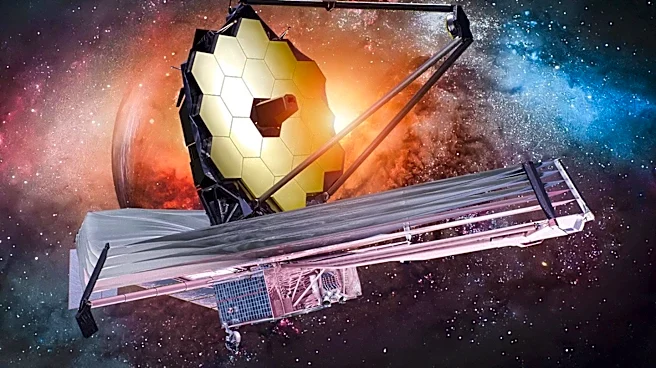
far exceeding what is expected for a massive star of its type, with temperatures around 150 million degrees and roughly forty times brighter. Using the Resolve microcalorimeter aboard the X-Ray Imaging and Spectroscopy Mission, the team measured the X-rays in motion. Their observations, taken across the star's orbital swing, revealed that the iron lines in the X-ray spectrum shifted in a manner consistent with the motion of an unseen companion object, rather than the Be star itself. This finding confirms that the X-rays originate from an accreting white dwarf companion, resolving a nearly fifty-year-old astronomical mystery.
Why It's Important?
This discovery significantly advances the understanding of binary star systems and the processes that generate high-energy emissions in space. For the U.S. astronomical community and space research, it provides crucial data for refining models of stellar evolution, particularly for Be stars and their companions. The identification of an accreting white dwarf as the source of these powerful X-rays helps to close a long-standing gap in population models, which predict a higher fraction of Be stars with white dwarf companions than previously observed. This research also validates the capabilities of advanced X-ray observatories like the X-Ray Imaging and Spectroscopy Mission, demonstrating their ability to provide detailed spectral and kinematic data essential for solving complex astrophysical puzzles. Understanding these extreme environments can also inform broader studies of accretion physics and high-energy phenomena throughout the universe.
What's Next?
Future research will likely focus on further characterizing the accreting white dwarf companion of Gamma Cassiopeiae, including its rotation period, magnetic field, and accretion rate, which remain unmeasured. The study also calls for new hydrodynamical simulations specifically designed for Be star and white dwarf pairs, incorporating radiative transfer, to better understand the observed phenomena. Astronomers will also investigate why the X-rays persist even when the disc feeding the white dwarf has largely dissipated. Additionally, the discrepancy between population models and observed frequencies of white dwarf companions around early-type Be stars will require further investigation, potentially leading to revisions in stellar evolution theories. Continued observations of Gamma Cas analogues will be crucial to confirm these findings and explore the diversity of such systems.
Beyond the Headlines
This resolution of the Gamma Cassiopeiae mystery has broader implications for how scientists approach anomalies in astronomical observations. It underscores the importance of persistent, long-term research and the development of advanced instrumentation to unravel complex cosmic phenomena. The finding also highlights the interconnectedness of different fields within astrophysics, as insights from stellar evolution, binary star dynamics, and high-energy physics converge to explain a single object. Furthermore, the study's call for new modeling techniques emphasizes the continuous need for theoretical advancements to keep pace with observational capabilities. This iterative process of observation, hypothesis, and refined modeling is fundamental to scientific progress and our understanding of the universe's intricate workings.