
What's Happening?
The Philippines and the United States conducted a joint military exercise at the Scarborough Shoal in the South China Sea, a region claimed by both the Philippines and China. This exercise marks the 11th
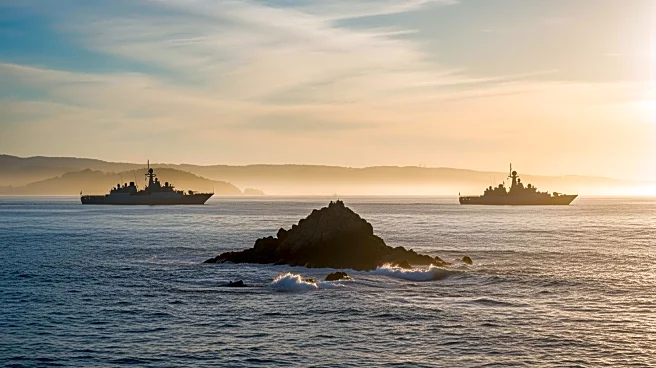
such drill since November 2023, reflecting increased military cooperation under Philippine President Ferdinand Marcos Jr., who has strengthened ties with Washington in response to China's expanding influence in the area. The drill involved the Philippines' frigate Antonio Luna, a coast guard patrol vessel, and several aircraft, while the U.S. contributed the John Finn, a guided missile destroyer, and an MH-60R Seahawk helicopter. The exercises aim to enhance coordination and tactical proficiency between the two nations' forces. Meanwhile, China's Southern Theater Command conducted its own patrols in the South China Sea, asserting its territorial claims and criticizing the joint patrols as disruptive to regional peace.
Why It's Important?
This joint military exercise underscores the strategic importance of the South China Sea, a vital maritime route with significant geopolitical implications. The increased military collaboration between the Philippines and the U.S. highlights a shift in regional alliances, as the Philippines seeks to counterbalance China's assertive territorial claims. This development could influence U.S. foreign policy and military strategy in the Indo-Pacific region, potentially affecting trade routes and regional security dynamics. The exercise also signals to other Southeast Asian nations the potential for increased U.S. involvement in regional security, which could alter the balance of power and influence diplomatic relations in the area.
What's Next?
Future military engagements between the Philippines and the U.S. are likely, as both nations continue to strengthen their defense ties. This could lead to more frequent joint exercises and increased U.S. military presence in the region. China's response to these developments will be critical, as it may escalate its own military activities or seek diplomatic solutions to assert its claims. The situation could also prompt other regional players to reassess their security strategies and alliances, potentially leading to a more complex geopolitical landscape in the South China Sea.