






What's Happening?
The Cook Political Report has reclassified Iowa's U.S. Senate race from 'leans Republican' to a 'toss-up.' This shift indicates a tightening contest between Republican Ashley Hinson and Democrat Josh Turek. Previously, the race was considered to favor
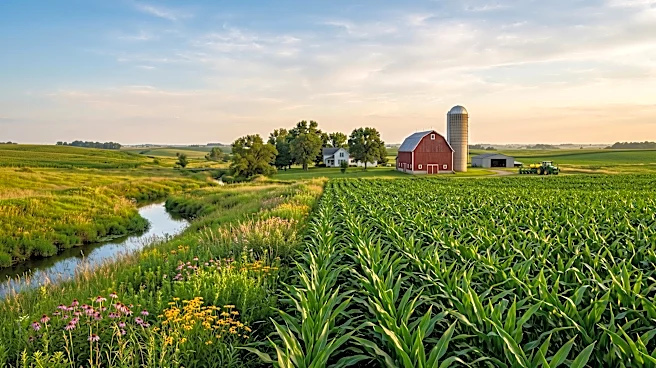
the Republican candidate. However, recent private polling suggests that Turek is now within the margin of error, potentially even ahead. This change in classification is attributed to both public and private polling data, alongside a challenging political environment for Republicans. Economic pressures, particularly within Iowa's agriculture industry, are cited as a contributing factor to this evolving political landscape. Concurrently, the Cook Political Report also indicates that Iowa's governor's race is now leaning Democratic, with Democrat Rob Sand, the state auditor, running against Republican Zach Lahn.
Why It's Important?
The reclassification of Iowa's U.S. Senate race to a 'toss-up' signifies a potentially significant shift in the national political landscape, particularly for the Republican party. Iowa, often considered a reliably red state, showing a competitive Senate race and a Democratic-leaning gubernatorial race could indicate broader electoral challenges for Republicans. This development suggests that economic factors, such as pressures on the agriculture industry, are playing a crucial role in voter sentiment and could influence outcomes in other states with similar economic bases. For Democrats, this presents an unexpected opportunity to gain a Senate seat, which could be pivotal in the overall balance of power in the U.S. Senate. The outcome of this race will be closely watched as an indicator of national political trends and the effectiveness of different campaign strategies in addressing economic concerns.
What's Next?
As the Iowa U.S. Senate race is now considered a 'toss-up,' both Republican Ashley Hinson and Democrat Josh Turek are expected to intensify their campaign efforts. This will likely involve increased advertising, more frequent public appearances, and a focus on mobilizing their respective voter bases. The economic pressures on Iowa's agriculture industry will likely remain a central theme in campaign messaging, with candidates attempting to demonstrate their plans to address these concerns. Political analysts will closely monitor further polling data and campaign developments to gauge the trajectory of the race. The outcome will not only determine who represents Iowa in the U.S. Senate but could also influence the national balance of power, potentially leading to increased focus and resources from national party organizations into the state.
Beyond the Headlines
The shift in Iowa's political landscape, particularly the tightening Senate race and the Democratic lean in the gubernatorial contest, highlights the profound impact of economic conditions on electoral outcomes. The challenges faced by the agriculture industry in Iowa underscore how specific sector-based economic issues can ripple through the broader electorate, potentially altering long-held political alignments. This situation could serve as a case study for future elections, demonstrating how candidates' abilities to address tangible economic hardships can sway voters, even in states with established political leanings. It also raises questions about the long-term stability of traditional party strongholds and the increasing volatility of voter preferences in response to economic fluctuations and perceived governmental effectiveness.