







What's Happening?
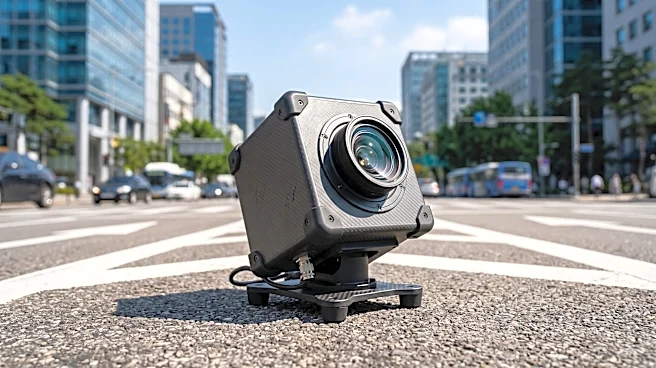
The Tokyo Metropolitan Police Department (MPD) is set to introduce a new system that utilizes artificial intelligence (AI) for reconstructing traffic accidents. This innovative system will combine AI with 3D spatial data from accident sites and footage
from nearby security cameras. The primary goal is to reduce the need for lengthy on-site inspections, which currently require traffic restrictions lasting two to three hours and often mobilize more than 20 personnel, leading to significant congestion and economic losses. The MPD plans to test the new system starting in June 2027, with full-scale operations anticipated to begin in January 2028. Related expenses for this initiative have been included in the police department's budget request for the next fiscal year.
Why It's Important?
While this development is occurring in Tokyo, its implications are relevant to U.S. cities facing similar challenges with traffic congestion and accident investigation. In the U.S., traffic accidents often lead to prolonged road closures, causing substantial economic losses due to delays in commerce and commuting. The adoption of AI-based reconstruction systems could offer a blueprint for U.S. law enforcement agencies to streamline accident investigations, significantly reducing the time roads are closed. This would translate into less traffic congestion, lower fuel consumption, and improved air quality. Furthermore, by freeing up police personnel from lengthy on-site duties, resources could be reallocated to other critical public safety functions, enhancing overall operational efficiency.
What's Next?
The Tokyo MPD will begin testing the AI-based system in June 2027, with full implementation slated for January 2028. During this testing phase, the system's effectiveness in accurately reconstructing accidents and reducing on-site inspection times will be evaluated. If successful, this technology could become a standard practice, not only in Tokyo but potentially inspiring similar initiatives in major U.S. metropolitan areas. U.S. law enforcement and transportation agencies will likely observe Tokyo's progress closely, considering how such AI solutions could be adapted to their own operational contexts and regulatory environments. The integration of AI into accident investigation represents a significant step towards modernizing police procedures and improving urban mobility.
Beyond the Headlines
The introduction of AI in accident reconstruction raises several deeper implications. Ethically, the accuracy and impartiality of AI algorithms in determining fault and contributing factors in accidents will be paramount. Legal frameworks may need to evolve to accommodate AI-generated evidence in court proceedings. Culturally, there might be a shift in public perception regarding the role of technology in law enforcement and justice. This development also highlights the increasing convergence of technology and public services, pushing the boundaries of what is possible in urban management. The long-term impact could be a more efficient, data-driven approach to public safety and urban planning, but it will require careful consideration of data privacy, algorithmic bias, and the human element in critical decision-making processes.