




What's Happening?
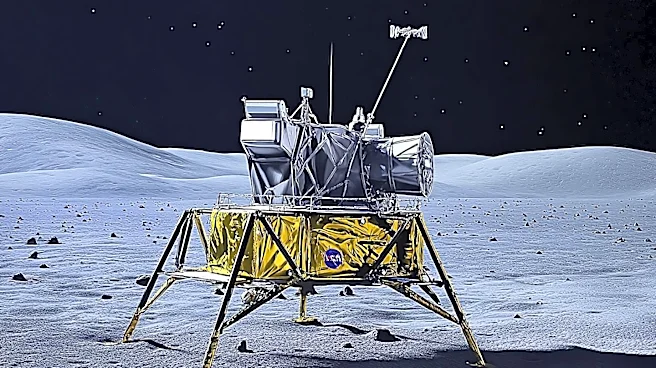
Firefly Aerospace, in collaboration with Zeno Power, will fly a radioisotope heating unit (RHU) on an upcoming lunar lander mission scheduled for 2028. This mission aims to test a 'Survive-the-Night' package designed to keep components warm during the extreme
cold of the lunar night, where temperatures can drop to minus 170 degrees Celsius. The package will utilize a small RHU, approximately the size of a silver dollar, containing americium-241, a radioactive isotope, to generate 5 watts of thermal energy. This demonstration is intended to prove the viability of such technology for future lunar operations. The primary goal of the package is to send a signal back after five days into the lunar night, confirming its continued functionality. This initiative aligns with NASA's incentive for Commercial Lunar Payload Services (CLPS) task orders to develop and demonstrate survive-the-night capabilities.
Why It's Important?
The ability to survive the lunar night is crucial for establishing a sustainable human presence on the Moon and for extending the operational lifespan of lunar missions. Currently, the extreme temperature drops during the lunar night pose a significant challenge, often leading to the failure of electronic components. By successfully demonstrating a radioisotope heating unit, Firefly Aerospace and Zeno Power could provide a critical solution to this problem, enabling longer-duration missions and supporting NASA's Moon Base initiatives. This technology could significantly reduce the costs associated with frequent mission launches and enhance the scientific data collection capabilities on the lunar surface. Furthermore, this mission serves as a regulatory pathfinder for the commercial use of radioisotope power sources in space, potentially opening doors for broader applications in future space exploration and commercial ventures.
What's Next?
Following this initial demonstration in 2028, Zeno Power plans to scale up the production of RHUs to meet anticipated demand from NASA, industry, and international partners for future lunar missions. The company is also developing radioisotope power sources that incorporate Stirling generators to produce electrical power. Firefly Aerospace will assess the results of this mission to determine how best to integrate this technology into future landers, either for specific payloads or for the entire lander system. The success of this mission will also inform regulatory processes for nuclear payloads in space, which are currently being established. Another company, Intuitive Machines, also plans to pursue a similar survive-the-night incentive using an americium-241 RHU on its own lunar lander mission, highlighting a growing industry focus on this critical capability.
Beyond the Headlines
The successful deployment and operation of a radioisotope heating unit on the Moon carries significant implications beyond immediate mission objectives. It represents a crucial step towards overcoming one of the most formidable environmental challenges in lunar exploration, potentially enabling continuous operations and reducing reliance on solar power, which is unavailable during the lunar night. This advancement could foster the development of more robust and self-sufficient lunar infrastructure, paving the way for long-term scientific outposts and resource utilization. The regulatory framework established through this and similar missions will be vital for the safe and responsible expansion of nuclear power applications in space, balancing innovation with environmental and safety concerns. This technology could also have broader applications for deep space missions where solar power is not feasible, pushing the boundaries of human and robotic exploration.