
What's Happening?
Mira Bar-Matthews, a researcher at the Geological Survey of Israel, has been awarded the 2026 Israel Prize in Geology and Earth Sciences for her pioneering work in using cave deposits to study past climates.
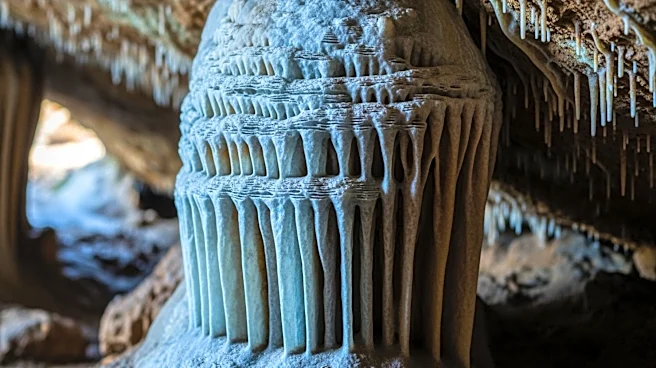
Her research focuses on speleothems, such as stalactites and stalagmites, which serve as natural archives to reconstruct climate conditions and earthquake activity over extensive periods. Bar-Matthews' work has demonstrated how these formations can preserve detailed records of past climate conditions, precipitation patterns, and even ancient seismic events. Her studies have significantly contributed to understanding the environmental and tectonic history of regions like the Mediterranean and the Middle East.
Why It's Important?
Bar-Matthews' research is crucial as it provides a deeper understanding of Earth's climate history, which is essential for predicting future climate changes. By establishing a reliable method to date and analyze cave deposits, her work offers insights into the timing, pace, and magnitude of climate shifts. This research is particularly relevant in the context of current climate change, as it helps scientists understand historical climate patterns and their impacts on human societies. The ability to detect ancient earthquakes through these deposits also enhances the understanding of seismic risks, contributing to better preparedness and risk assessment in earthquake-prone areas.
What's Next?
The methodologies developed by Bar-Matthews are likely to be applied to other regions, expanding the global paleoclimate database. This could lead to more comprehensive models of past climate conditions and improve predictions of future climate scenarios. Additionally, her work in paleoseismology may inspire further research into using natural formations to study seismic activity, potentially leading to advancements in earthquake prediction and risk management.
Beyond the Headlines
Bar-Matthews' work highlights the interdisciplinary nature of Earth sciences, combining geology, chemistry, and environmental science. Her research underscores the importance of natural archives in understanding Earth's history and the potential for these methods to uncover new insights into climate and tectonic processes. The recognition of her work also emphasizes the role of women in science and the importance of supporting diverse perspectives in research.