







What's Happening?
The U.S. military is actively preparing for a future where artificial intelligence (AI) will play a central role in warfare, characterized by software fighting software. This shift is driven by observations from conflicts like the war in Ukraine, where both
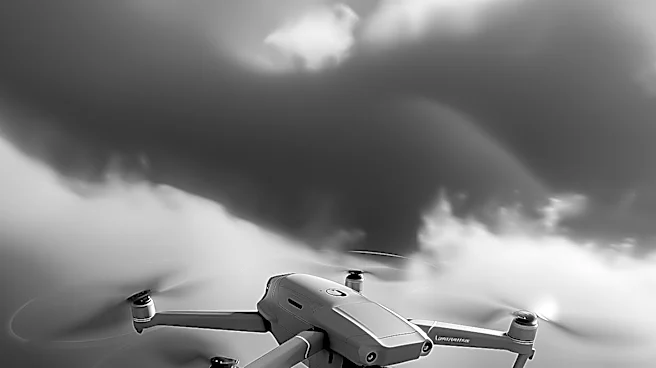
sides are rapidly integrating drones, electronic warfare, computer vision, and varying degrees of autonomy into their operations. Ukrainian developers have created systems capable of recognizing targets and continuing attacks even after communication disruptions, while Russia has incorporated sophisticated cameras, computing hardware, and anti-jamming technology into its drones. The U.S. Department of Defense (DoD) aims to become an 'AI-first' fighting force, with initiatives like DARPA's Artificial Intelligence Reinforcements program developing AI-driven autonomy for multi-aircraft combat and the testing of AI-controlled F-16s. NATO's 2026 digital strategy also advocates for broader AI utilization, predictive analysis, tactical-edge computing, and enhanced integration between sensors and weapons. This technological acceleration is compressing the time between observation and action, leading to scenarios where machines operate at speeds beyond human capacity.
Why It's Important?
The increasing reliance on AI in military operations has profound implications for U.S. national security and global power dynamics. The ability of AI systems to process vast amounts of data, track numerous objects, and adapt to electronic interference at machine speed offers a significant tactical advantage, potentially saving lives by enabling faster defensive reactions. However, this acceleration also introduces complex challenges regarding human control and accountability. As AI systems make more decisions autonomously, the traditional chain of command and human judgment in critical moments could be diminished. The article highlights a potential future where human reaction time becomes a tactical disadvantage, forcing commanders to delegate more decision-making to machines. This shift could lead to an AI arms race where software capabilities, data quality, and rapid model updates become as crucial as traditional military hardware, altering the balance of power in ways that are harder to measure than conventional arms. The ethical dilemma of responsibility in the event of an autonomous system's failure also becomes more pronounced, as blame could be diffused across multiple actors and systems.
What's Next?
The U.S. military will continue to invest heavily in AI research and development, focusing on integrating AI into various aspects of warfare, from intelligence analysis to autonomous weapon systems. This includes ongoing testing of AI-controlled aircraft and the development of advanced defensive and offensive AI capabilities. The emphasis will be on creating systems that can operate effectively in environments with heavy electronic warfare and sophisticated deception tactics. Policy discussions will likely intensify regarding the appropriate levels of human judgment and control over autonomous weapons, especially as the speed of warfare accelerates. The U.S. will also need to address the challenge of maintaining a human decision requirement in critical areas, such as nuclear employment, while leveraging AI for information processing. Furthermore, the military will need to develop robust testing protocols that account for deception and chaotic battlefield conditions, ensuring that AI systems can perform reliably when circumstances deviate from their initial assumptions. The continuous collection and analysis of battlefield data, as demonstrated by Ukraine, will be crucial for training and updating AI models.
Beyond the Headlines
The rapid integration of AI into warfare raises fundamental questions about the nature of conflict, human agency, and ethical responsibility. The scenario of 'software fighting software' suggests a future where military engagements could unfold at speeds incomprehensible to human operators, potentially leading to unintended escalations. The article points out that machines, devoid of emotions like hatred or fear, could trigger escalations simply by reacting to each other based on pre-programmed rules, even if those rules made sense at the time of their creation. This highlights the critical need for mechanisms that allow humans to override technically correct but potentially catastrophic machine decisions. The concept of deception in an AI-driven battlefield also evolves, as adversaries will design camouflage and electronic signatures specifically to fool computer vision and AI models. This creates a complex environment where the 'reality' interpreted by AI systems can be deliberately manipulated. Ultimately, the challenge lies in ensuring that as machines take on more responsibility in warfare, humans retain meaningful control and accountability, preventing a future where the appearance of responsibility masks a dilution of actual command.