
What's Happening?
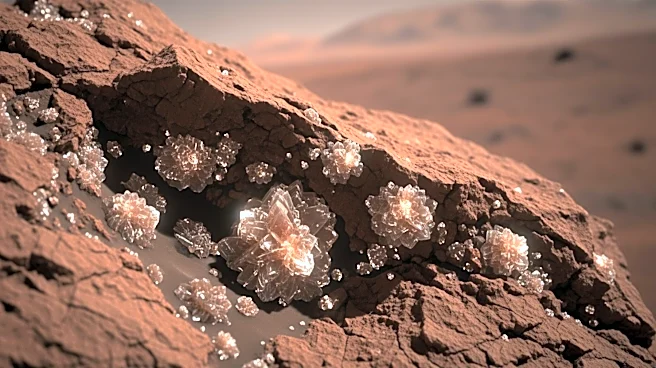
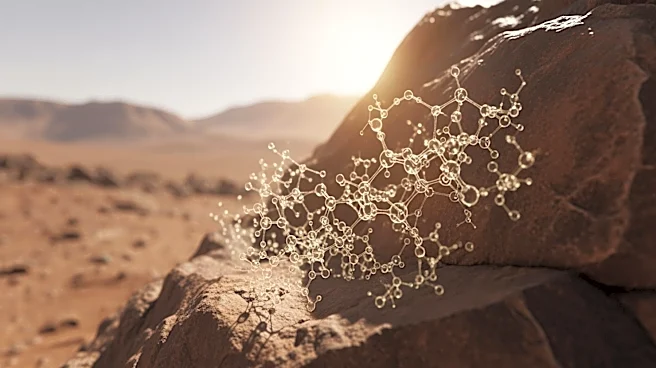
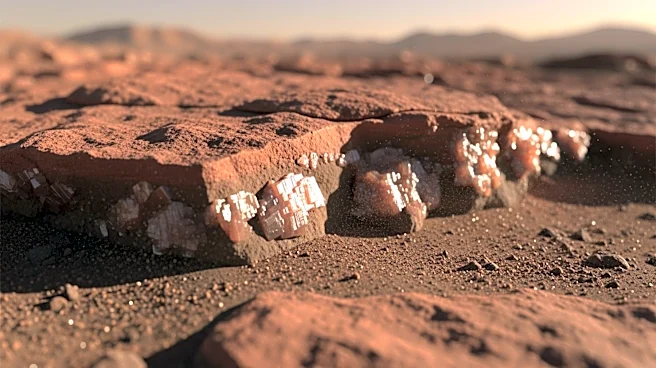
The Curiosity rover has detected over 20 organic molecules, including aromatic and sulfur-containing compounds, in 3.5-billion-year-old Martian claystones. This discovery was made using a wet chemistry
experiment that successfully extracted these preserved organics from ancient bedrock. The findings demonstrate that Martian organic matter can survive billions of years of radiation and diagenesis. The study focused on the Mary Anning 3 target in Gale crater, using the rover's Sample Analysis at Mars (SAM) instrument to perform the first in situ thermochemolysis experiment on Mars. This technique released previously unextractable organic matter, providing new insights into the planet's past habitability.
Why It's Important?
The detection of complex organic molecules on Mars is a significant step in understanding the planet's potential for past life. These findings suggest that Mars had the necessary conditions to preserve organic matter over geological timescales, which is crucial for assessing its habitability. The study also advances the techniques used in planetary exploration, demonstrating the capability to analyze and extract organics directly on Mars. This could inform future missions, including those searching for biosignatures, and enhance our understanding of the planet's geological and chemical history.
What's Next?
Future missions may build on these findings to explore other regions of Mars for similar organic compounds. The successful application of thermochemolysis on Mars opens new possibilities for in situ analysis of Martian samples, potentially leading to the discovery of biosignatures. Researchers will continue to refine these techniques and apply them to other planetary bodies, expanding the search for life beyond Earth. The study also sets the stage for the upcoming Rosalind Franklin rover mission, which aims to further investigate Martian organics.