



What's Happening?
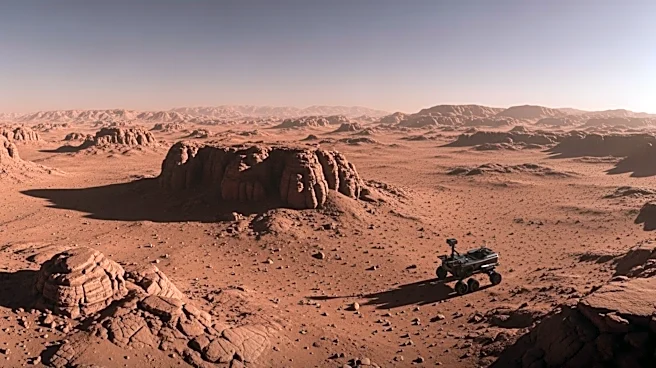
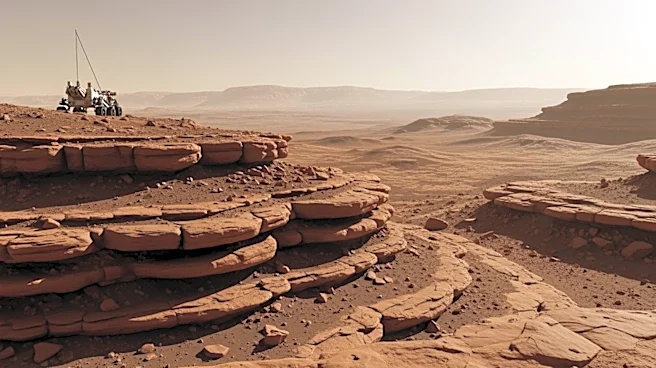
NASA has released a new timelapse video showcasing the journey of the Curiosity rover on Mars over the past six years. The video, composed of images captured by the rover's right navigation camera, highlights its exploration of the Gale Crater and ascent
of Mount Sharp. This visual documentation serves not only as a retrospective of the rover's mission but also as a scientific tool for analyzing Martian sand movement, which provides insights into seasonal atmospheric changes. Since its landing on Mars in 2012, Curiosity has been tasked with determining the planet's habitability. It has successfully identified 21 organic molecules in rock samples, suggesting potential past life-supporting conditions, although these could also result from non-biological processes.
Why It's Important?
The findings from Curiosity's mission are crucial for understanding Mars' past environment and assessing its potential to have supported life. The detection of organic molecules, including complex carbon materials, is significant as it hints at the possibility of ancient life forms. This research not only advances our knowledge of Mars but also informs future missions, such as those involving the Perseverance rover, which is equipped with more durable wheels to withstand the harsh Martian terrain. The ongoing analysis of Martian sand and atmospheric conditions could also aid in preparing for human exploration by providing data on environmental challenges.
What's Next?
NASA continues to monitor Curiosity's condition, particularly its wheels, which have suffered damage from the rocky Martian surface. Engineers have implemented strategies like driving in reverse and software upgrades to mitigate further wear. The insights gained from Curiosity's mission will guide the design and operation of future rovers, including Perseverance, which is already benefiting from improved wheel technology. As Curiosity continues its exploration, it will provide more data on Mars' geological and atmospheric conditions, contributing to the broader goal of understanding the planet's history and potential for life.