




What's Happening?
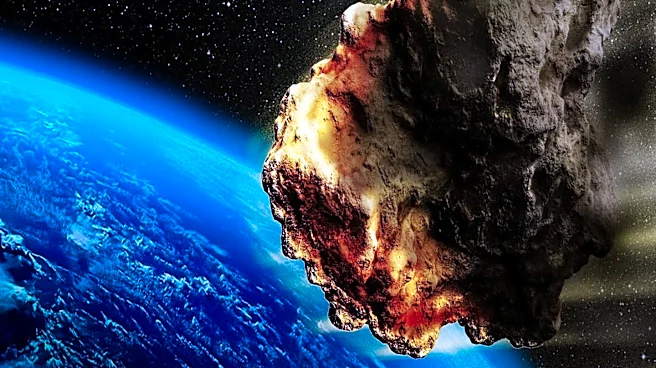
An amateur astronomer, Joël Lapointe, discovered a massive crater in Quebec's Côte-Nord region using Google Maps. The crater, centered on Lake Marsal, is suspected to be the result of a meteorite impact. Lapointe reported his findings to Impact Earth,
a crowdsourcing platform associated with Canada's Western University. Western planetary geologist Gordon Osinski visited the site in 2025 and provisionally confirmed the crater, which is approximately 15 miles wide and 390 million years old. The discovery is significant as it is one of the largest craters found in recent years. The crater, named Uhackatik, lies within the traditional lands of the Innu Council of Ekuanitshit. Osinski's expedition revealed 'shock metamorphic effects' and 'impact melt rocks,' which are indicative of a meteorite impact. The findings will be presented at the 88th Annual Meeting of the Meteoritical Society in Frankfurt, Germany.
Why It's Important?
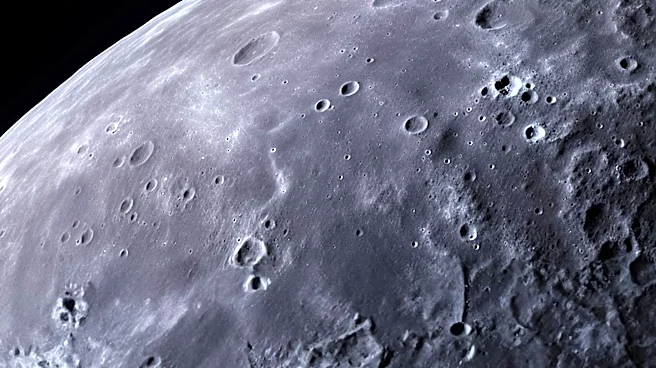
The discovery of the Uhackatik crater is significant for several reasons. It provides valuable insights into the history of meteorite impacts on Earth, which can help scientists understand similar events on other celestial bodies like the moon and Mars. The crater's age and size make it a rare find, as geological activity and erosion often obscure such features over time. This discovery also highlights the potential for amateur astronomers to contribute to scientific knowledge. The findings could lead to further research and exploration of the region, enhancing our understanding of Earth's geological history and the impact of extraterrestrial objects.
What's Next?
The research on the Uhackatik crater is ongoing, with plans to present the findings at an upcoming scientific conference. This could lead to further studies and potential collaborations with other researchers interested in impact craters. The Innu Council of Ekuanitshit, whose traditional lands include the crater, may also play a role in future explorations and studies. The discovery could inspire more amateur astronomers to participate in similar projects, potentially leading to more significant findings in the future.